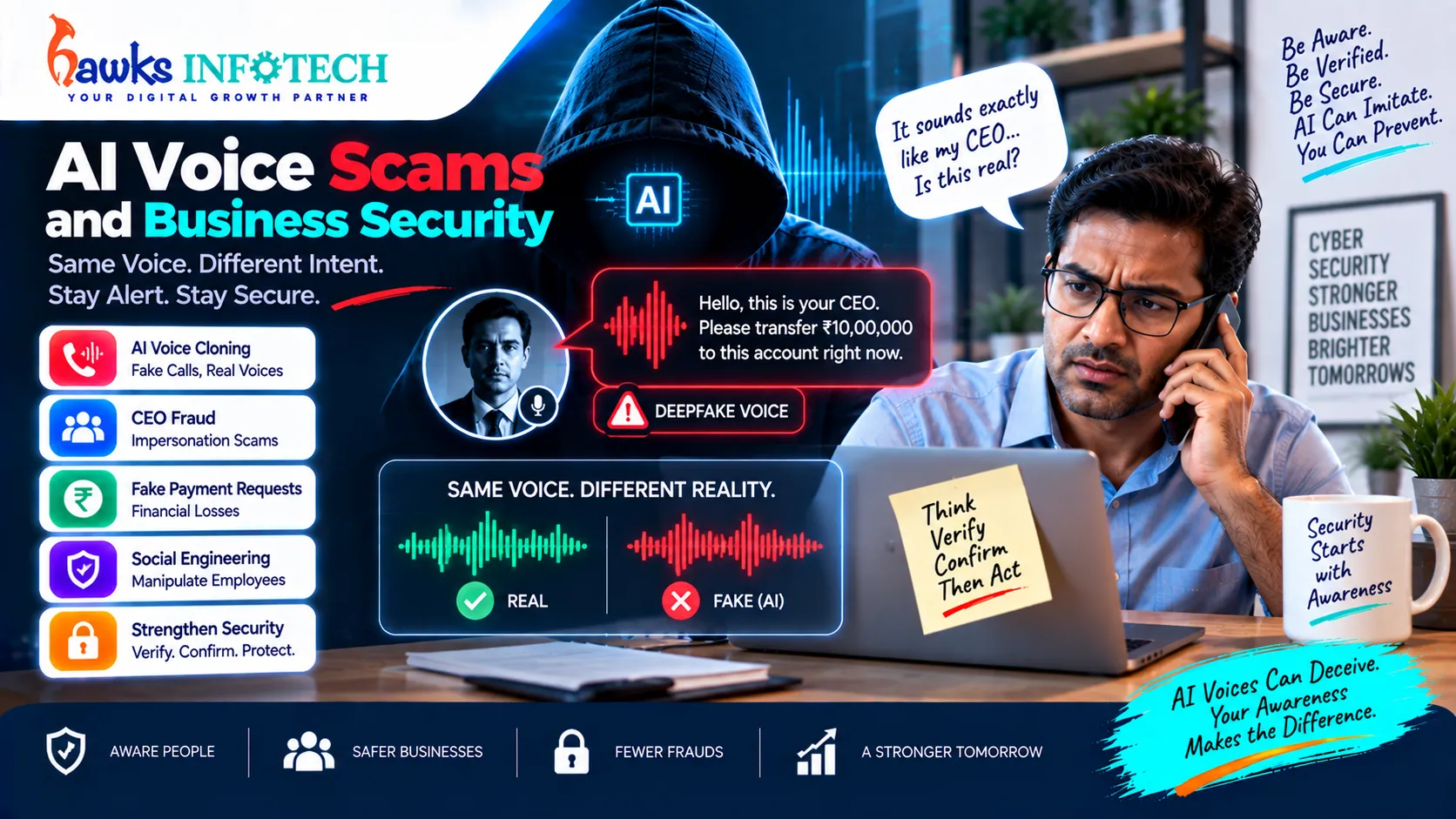
For over a century, hearing a familiar voice on the other end of a telephone line was the definitive gold standard of identity verification. If you recognized the voice of your CEO, your supplier, or your corporate attorney, you trusted the conversation. In 2026, artificial intelligence has permanently shattered that trust. With just three seconds of sample audio, modern neural voice cloning tools can replicate any human voice with 99.4% acoustic accuracy—complete with authentic regional accents, breathing hesitations, and emotional inflections.
The Vishing Threat
Voice phishing (vishing) attacks powered by conversational AI can hold dynamic, multi-turn phone conversations with accounting personnel to bypass financial controls.
Cryptographic Trust
Businesses must transition from acoustic voice trust to cryptographic multi-factor authorization and structured verbal challenge protocols.
Supporting Deep-Dive Guide
Master Pillar: AI-Powered Cybersecurity Threats in 2026
Table of Contents
Direct Answer: How do you protect your business from AI voice scams?
To prevent AI voice cloning fraud, organizations must: 1) Implement an immutable policy that prohibits financial wire releases or credential resets based solely on phone calls, 2) Establish private offline verbal passphrases for executive verifications, 3) Mandate direct callback procedures on pre-verified internal extensions, and 4) Deploy enterprise cybersecurity controls.
1. The Technology Behind AI Voice Cloning in 2026
Early text-to-speech synthesizers produced mechanical, robotic voices that anyone could immediately distinguish. Modern generative voice engines utilize deep neural autoencoders and diffusion acoustic modeling:
- Zero-Shot Voice Cloning: A neural model requires less than three seconds of recorded speech to extract the speaker's vocal tract geometry, pitch harmonics, cadence, and breath acoustics.
- Real-Time Latency Reduction: In 2026, inference latency has dropped below 150 milliseconds, allowing threat actors to pipe text through voice models in real time during live phone conversations.
- Emotional Modulation: Attackers can adjust prompts to inject emotional stress, background airport noise, or office commotion into the audio stream to manipulate the victim's psychological urgency.
This acoustic deception connects directly with broader social engineering vectors analyzed in protecting employees from AI phishing and deepfake fraud.
2. Three Common Corporate Voice Scam Scenarios
Scenario A: The Urgent CEO Wire Transfer Call
An accounts executive receives a phone call from the Managing Director: "Vikram, I'm boarding a flight to London. Our key logistics supplier in Singapore hasn't received their escrow deposit and is threatening to halt customs clearance. Transfer $85,000 immediately to the revised account in your inbox." The voice is identical, complete with ambient terminal boarding announcements.
Scenario B: The IT Helpdesk Password Reset Vishing
An attacker phones a branch employee posing as the internal corporate IT helpdesk manager: "Hi Priya, we've detected suspicious logins on your workstation. I need you to read me the 6-digit verification code sent to your phone right now so I can lock the account."
Scenario C: The Executive Kidnapping & Extortion Hoax
Family members or executive assistants receive a panicked, weeping phone call cloned in the executive's voice claiming they have been involved in an accident or detained, demanding immediate ransom funds via cryptocurrency or UPI.
3. Technical Vulnerabilities: Caller ID Spoofing & VoIP Networks
What makes AI voice attacks so persuasive is that they are almost always paired with Caller ID Spoofing. Using digital SIP trunking and VoIP services, an attacker in Eastern Europe can display the exact corporate headquarters phone number on the victim's smartphone screen.
When the victim looks at their phone, sees the CEO's name and office number, and hears the CEO's authentic voice, natural skepticism is completely disarmed. That is why phone calls can never be accepted as standalone proof of authorization.
4. The "Code Word" & Out-of-Band Defense Architecture
To neutralize voice cloning, organizations implement a resilient two-factor operational protocol:
The Pre-Established Code Word
A randomized alphanumeric passphrase or memorable phrase agreed upon in person and never stored in email, Slack, or cloud files. If a caller cannot recite the passphrase, the transaction is immediately halted.
The Out-of-Band Callback Policy
Staff are required to say: "Understood, sir. Company policy requires me to disconnect and call you back on your registered executive mobile line." Because spoofed VoIP calls cannot intercept return phone traffic, the attacker is severed.
5. Training Employees to Detect Synthetic Audio Flaws
While synthetic audio is convincing, attentive listeners can spot technical anomalies:
- Unnatural Audio Latency: A slight 1-second hesitation before the caller answers complex, unscripted interruptions while the AI processes text-to-speech inference.
- Robotic Cadence & Breathing Artifacts: A lack of natural breath pauses between long, complex sentences.
- Audio Texture Discrepancies: A metallic robotic buzz or digital clipping around hard consonants ("P", "B", "T").
- Evasive Responses to Personal Questions: If asked, "How did your daughter's tennis tournament go this weekend?", the AI will deflect: "We can talk about that later, right now this invoice is urgent."
6. The 5-Step Voice Security Implementation Checklist
- Formulate Written SOPs: Explicitly state that zero financial transfers may be authorized via voice, phone call, or WhatsApp voice memo without signed dual digital approvals.
- Deploy Secure Voice Channels: Transition internal executive communications to encrypted corporate communication platforms with verified directory accounts.
- Educate Executive Leadership: Ensure executives minimize publishing clean, uncompressed audio speeches on public social channels without noise filters.
- Implement Hardware MFA Tokens: Ensure IT password resets require physical FIDO2 keys rather than verbal phone authorizations.
- Engage Managed IT Security: Pair voice protocols with 24/7 endpoint defense and managed IT support to protect corporate networks.
7. Frequently Asked Questions
Can voice authentication (voice biometrics) be fooled by AI voice clones?
Yes. Major banking institutions and telecom providers that previously allowed customers to authenticate bank accounts using "My voice is my password" have experienced widespread bypasses. Modern security frameworks strongly advise against voice biometrics as a sole authentication factor.
How much does it cost an attacker to clone a voice?
Virtually nothing. Commercial text-to-speech tools cost as little as $5 per month, and free open-source voice cloning repositories on GitHub allow anyone with a basic gaming GPU to clone voices with near-zero financial cost.
How should a staff member respond if they suspect a voice clone scam?
Do not engage in confrontation. Simply state: "Company security protocol requires me to verify this request via an internal callback," hang up immediately, and alert the IT security team and the genuine executive on their verified private line.
Topical Cluster: AI-Powered Cybersecurity & Threat Defense
Explore the complete interconnected network of pillar guides and specialized deep-dive articles in this domain:

AI-Powered Cybersecurity Threats in 2026
Explore the comprehensive master guide that unifies all AI-Powered Cybersecurity & Threat Defense strategies.


