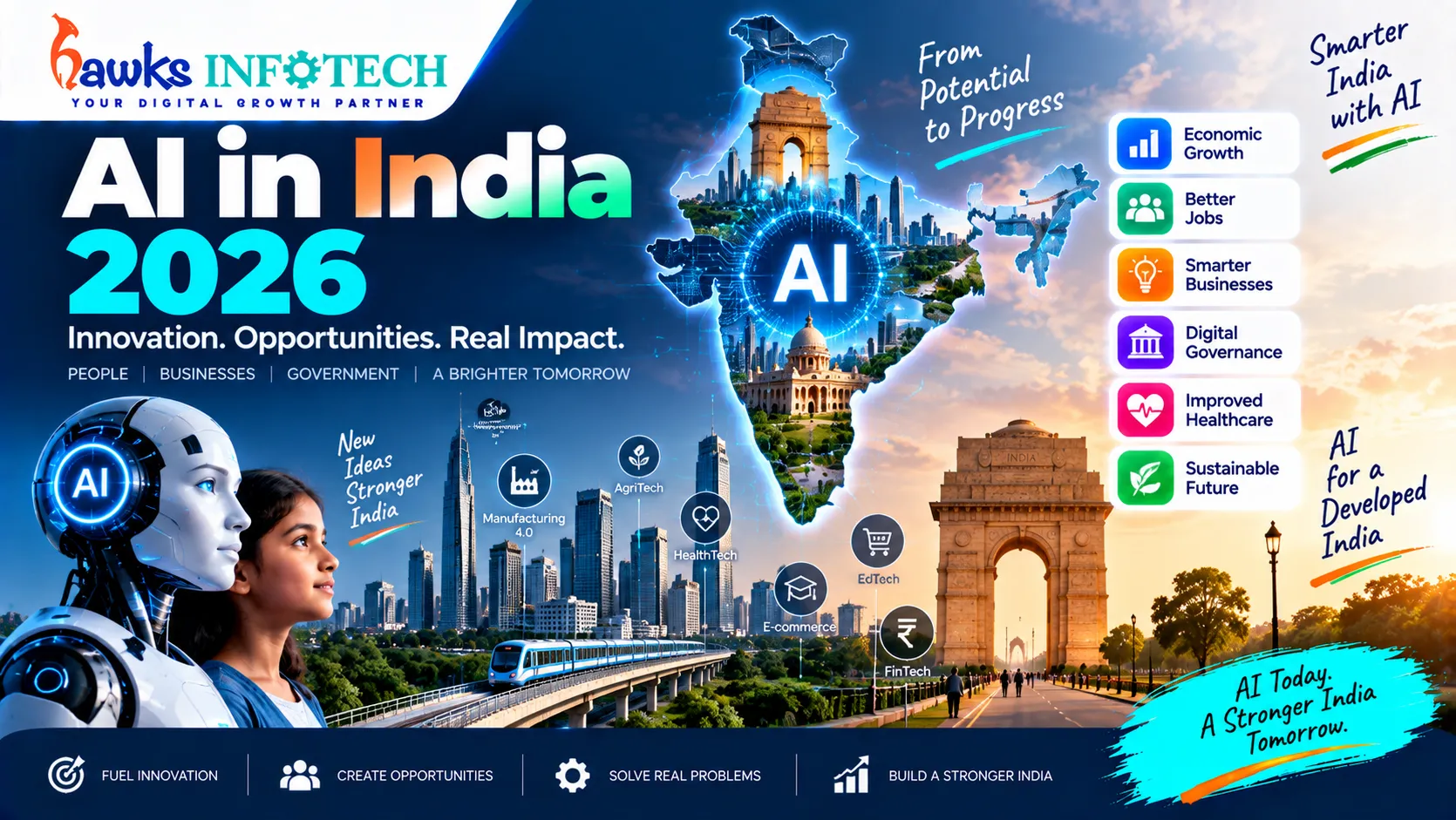
In 2026, India has firmly established itself not merely as an adopter of global artificial intelligence, but as an indispensable architect of the world's applied AI revolution. Powered by the central government's comprehensive ₹10,370+ crore IndiaAI Mission, massive investments in sovereign GPU compute clusters, and the world's most sophisticated Digital Public Infrastructure (DPI), India is demonstrating how advanced machine intelligence can be deployed at unprecedented planetary scale. From multilingual voice-enabled citizen governance to agile enterprise automation across Delhi NCR, Bengaluru, Mumbai, and Hyderabad, artificial intelligence is reshaping the Indian economic landscape.
The IndiaAI Sovereign Mission
National initiatives subsidize over 15,000 public GPUs, democratizing enterprise-grade computing for Indian deep-tech startups, academic researchers, and indigenous foundational models.
The Multilingual Bhashini Breakthrough
Voice-first, multilingual LLMs bridge digital literacy barriers across 22 scheduled Indian languages, enabling 900+ million non-English citizens to access digital commerce seamlessly.
Digital Marketing & AI in India Ecosystem
Comprehensive authority resource connecting all specialized sub-guides and actionable execution frameworks.
Table of Contents
Direct Answer: What is the state of AI in India in 2026?
In 2026, India is the world's fastest-growing AI deployment market, projected to contribute over $500 billion to national GDP by 2030. Key drivers include government-subsidized sovereign GPU infrastructure via the IndiaAI Mission, voice-first Indic language models (Bhashini) integrated into UPI and ONDC, and widespread adoption across enterprise hubs and small-to-medium enterprises upgrading their digital operations.
1. The Macro Picture: India’s AI Economic Inflection Point
India's unique demographic dividend—combining the world's largest STEM graduate workforce, ubiquitous affordable 5G connectivity, and the highest mobile data consumption per capita globally—has provided an ideal environment for rapid AI diffusion. In 2026, artificial intelligence is no longer restricted to IT services export giants (TCS, Infosys, Wipro); it is deeply embedded in domestic banking, manufacturing, logistics, healthcare, and retail sectors.
Economic studies estimate that generative and predictive AI technologies are poised to add between $450 billion and $550 billion to India’s gross domestic product by 2030. Indian corporations have transitioned from speculative proof-of-concept experiments into full production deployments, with over 72% of mid-sized and large enterprises utilizing machine learning systems in daily operational workflows.
This macroeconomic growth is particularly visible in localized enterprise automation initiatives, as examined in our study on AI automation for Delhi NCR businesses.
2. Sovereign Infrastructure: The IndiaAI Mission & GPU Capacity
Historically, Indian technology companies faced a significant handicap: critical compute infrastructure (Nvidia high-end H100/B200 GPU clusters) was heavily concentrated in North America and Western Europe, resulting in high latency, dollar-denominated cloud expenses, and data sovereignty concerns.
The launch of the government's IndiaAI Mission fundamentally transformed this equation:
- Democratized GPU Access: A public-private consortium has deployed over 15,000 top-tier AI compute chips available at subsidized rates to accredited Indian researchers, startups, and enterprises.
- Sovereign Foundational Models: Indian research labs (such as Sarvam AI, Krutrim, and IIT consortia) have trained indigenous large language models built from the ground up on culturally nuanced, multilingual Indian text corpora.
- National Data Repository: The IndiaAI Datasets Platform provides curated, non-personal datasets across agriculture, municipal governance, healthcare, and public transport, enabling developers to train high-accuracy vertical models.
3. Bhashini & Indic LLMs: Solving India’s Linguistic Diversity
One of the greatest historical barriers to digital inclusion in India has been language. While English dominates web interfaces and corporate communication, fewer than 12% of the Indian population speaks fluent English.
Through Project Bhashini (National Language Translation Mission), India has solved this structural bottleneck:
Voice-First UPI Payments
Citizens in rural and semi-urban areas execute secure peer-to-peer bank transfers simply by speaking commands in Marathi, Tamil, Bengali, or Hindi into conversational voice bots.
ONDC Commerce Voice Assistants
Local kirana store owners upload inventory and negotiate buyer requests across the Open Network for Digital Commerce using real-time audio translation tools.
Omnichannel Customer Support
Indian consumer brands resolve customer inquiries over WhatsApp and automated phone lines in regional mother tongues with sub-second response times.
For a breakdown of specific software tools powering these localized workflows, explore our guide to the best AI tools for Indian businesses.
4. Enterprise & SME Adoption Across Regional Commercial Hubs
The geography of AI adoption in India extends far beyond traditional tech epicenters. While Bengaluru and Hyderabad remain the primary hubs for deep-tech R&D, regional commercial clusters are driving mass industrial deployment:
- Delhi NCR (Gurugram, Noida, Faridabad): Rapid enterprise adoption in fintech, corporate headquarters, supply chain logistics, and B2B SaaS operations, supported by advanced IT support and infrastructure management.
- Mumbai & Pune: Banking, financial services, insurance (BFSI), and automotive manufacturing plants deploying computer vision for real-time assembly line defect detection and automated fraud underwriting.
- Tier-2 & Tier-3 Manufacturing Centers: Textile hubs in Surat and Coimbatore and light engineering clusters in Ludhiana and Rajkot deploying AI-driven predictive maintenance to prevent costly machine downtime.
A comprehensive roadmap of how traditional enterprises are managing this transition is detailed in our report on AI adoption in Indian SMEs.
5. Regulatory Landscape: Navigating the DPDP Act in the Age of AI
As AI adoption accelerates, regulatory compliance has become a boardroom priority. The formal enactment and enforcement of the Digital Personal Data Protection (DPDP) Act has established stringent guidelines for how businesses process personal customer data through machine learning models:
- Purpose Limitation and Explicit Consent: Businesses cannot indiscriminately scrape user interaction data or call recordings to fine-tune AI models without explicit, verifiable consent from Indian data principals.
- Data Minimization and Cross-Border Transfers: Enterprises must ensure that customer data sent to overseas cloud AI API providers adheres strictly to approved jurisdiction whitelists and enterprise data protection standards.
- Synthetic Media & Security Safeguards: With the rise of synthetic fraud targeting Indian firms, directors face legal obligations to implement deepfake defense protocols, as explored in deepfake fraud and Indian businesses.
6. Strategic Roadmap for Indian Business Leaders
To capitalize on India's AI momentum and outpace competitive disruption, executive teams must execute a deliberate three-step transformation strategy:
- Audit Data Architecture First: AI models are only as good as the internal data feeding them. Cleanse legacy ERP, CRM, and accounting records to establish a reliable single source of enterprise truth.
- Prioritize High-ROI Use Cases: Rather than attempting sprawling company-wide overhauls, deploy targeted AI solutions for customer support, lead qualification, or inventory optimization where payback periods are under 90 days.
- Invest in Continuous Workforce Upskilling: Equip front-line employees with prompt engineering and AI workflow orchestration skills, turning your existing team into an elite, highly productive operational unit.
7. Frequently Asked Questions
How is India's approach to AI different from the US and China?
While the US is primarily driven by private venture capital focusing on consumer foundational models, and China emphasizes state-controlled industrial applications, India has pioneered "AI as Public Good." India integrates open-source, affordable AI tools into sovereign digital public infrastructure (UPI, Aadhaar, ONDC, Bhashini) to drive inclusive economic empowerment at massive population scale.
Are Indian universities producing enough AI engineering talent?
India graduates over 1.5 million engineers annually and boasts the second-largest pool of AI developers on GitHub globally. With premier institutions (IITs, IIITs) establishing dedicated AI departments and national Centers of Excellence, the country's talent pipeline is rapidly shifting from conventional IT maintenance to cutting-edge AI architecture.
What industries in India will benefit most from AI in the next three years?
The biggest beneficiaries are Banking and Financial Services (automated underwriting and fraud detection), Healthcare (telemedicine diagnostics in rural clinics), Agriculture (satellite crop yield monitoring and weather forecasting), and E-commerce (multilingual voice commerce).
Topical Cluster: Digital Marketing & AI in India Ecosystem
Explore the complete interconnected network of pillar guides and specialized deep-dive articles in this domain:


