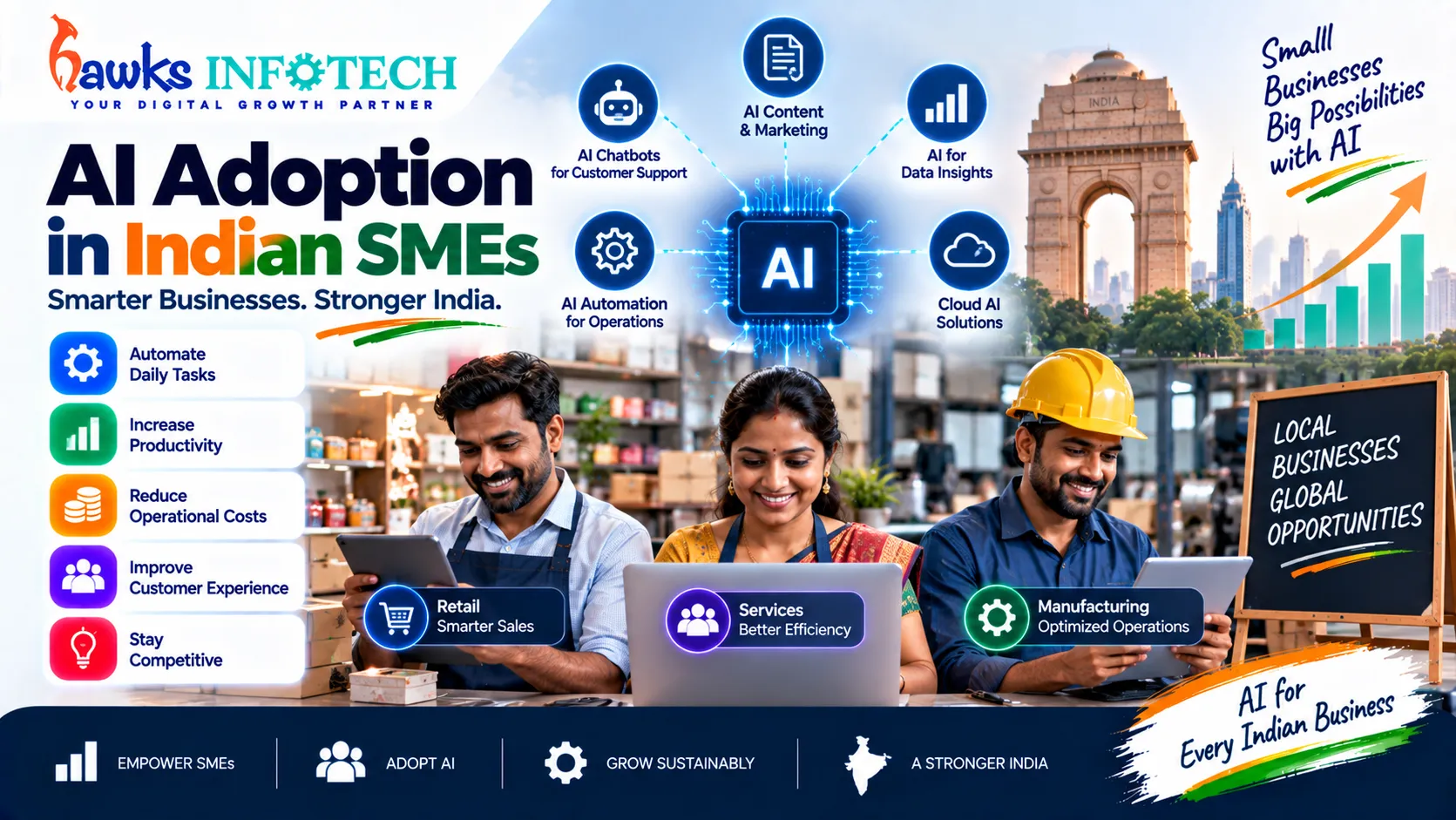
Micro, Small, and Medium Enterprises (MSMEs) represent the foundational engine of India's economic growth, contributing roughly 30% of national GDP, 45% of manufacturing output, and employing over 120 million people. Historically, advanced enterprise technologies—such as predictive enterprise resource planning (ERP), robotic process automation (RPA), and automated customer analytics—were the exclusive privilege of well-capitalized multinational corporations. In 2026, the proliferation of democratized cloud artificial intelligence, plug-and-play micro-SaaS applications, and low-cost computing has leveled the competitive playing field. Indian SMEs are aggressively adopting AI to overcome chronic labor bottlenecks, reduce operational overhead, and capture market share.
The Leapfrog Advantage
Indian SMEs bypass decades of cumbersome legacy software installations, adopting cloud-native, voice-first AI tools that run directly on mobile smartphones and tablets.
High-Speed Return on Investment
Targeted SME automation projects regularly achieve complete payback within 60 to 90 days by reducing inventory waste and recapturing lost customer leads.
Supporting Deep-Dive Guide
Master Pillar: AI in India 2026
Table of Contents
Direct Answer: How can Indian SMEs successfully adopt AI in 2026?
Indian SMEs should adopt a "Narrow, High-ROI" strategy: avoid custom AI software engineering and instead implement turnkey micro-SaaS tools. Focus on the three biggest cost and revenue drivers: 1) Automating customer WhatsApp inquiries and lead capture, 2) Utilizing AI-powered inventory forecasting to prevent working capital lockups, and 3) Automating routine GST invoice reconciliation to eliminate administrative compliance fines.
1. The State of AI Adoption in India's MSME Sector
According to recent industrial surveys by NASSCOM and MSME research councils, over 48% of formal Indian small-to-medium enterprises now utilize at least one AI-augmented software tool in their weekly operations. This marks a dramatic leap from barely 14% in 2023.
What catalyzed this massive adoption? It wasn't academic interest in neural networks; it was pure economic necessity. Rising input costs, intense competition from venture-funded e-commerce marketplaces, and severe talent shortages in administrative roles forced business owners to seek productivity leverage.
For business owners evaluating software tools, our curated review of the best AI tools for Indian businesses provides a structured comparison of available platforms.
2. Real-World High-ROI Use Cases for Indian SMEs
Successful SME AI deployments focus on pragmatic business outcomes rather than futuristic experiments. Across key Indian industry sectors, specific use cases are delivering immediate returns:
Light Manufacturing & Auto Ancillary (NCR, Pune, Chennai)
SMEs deploy edge computer vision cameras connected to low-cost microcomputers on factory floors. The AI inspects machined components, sheet metal stamping, and welding seams in real time, reducing defect escape rates by 84% without hiring additional quality control inspectors.
Textile & Apparel Exporters (Surat, Tirupur, Ludhiana)
Design houses utilize generative image synthesis to create dozens of seasonal fabric pattern samples and virtual garment catalog mockups in hours, slashing physical prototyping costs by over 70% before presenting collections to international buyers.
B2B Distribution & Wholesale Trading (Chawri Bazar, Chandni Chowk, Okhla)
Wholesalers deploy predictive inventory algorithms that analyze historical seasonal demand, festival surges (Diwali, Eid, Wedding seasons), and supplier lead times, preventing excess capital lockup in slow-moving stock.
Similar efficiency gains are documented in our broader study of how small businesses can use AI in 2026.
3. Key Obstacles: Why Indian Businesses Struggle & How to Overcome Them
Despite enthusiasm, many Indian SME owners experience failed software implementations. Understanding these common friction points is crucial to avoiding wasted capital:
- Unorganized Data & Paper Registers: AI algorithms cannot optimize operations if business records exist only in physical bahi-khata notebooks or disorganized Excel sheets. Moving to a digitized accounting foundation is mandatory.
- The "All-at-Once" Fallacy: Trying to automate sales, production, accounting, and HR simultaneously overwhelms employees and leads to operational chaos. Focus on one bottleneck at a time.
- Employee Apprehension: Staff often fear that AI tools will render their jobs obsolete. Business owners must proactively communicate that AI is designed to eliminate tedious data entry, not replace human workers.
4. Government Initiatives, Subsidies & Digital MSME Schemes
The Ministry of MSME and the Ministry of Electronics and Information Technology (MeitY) provide substantial institutional support to accelerate enterprise digitization:
Digital MSME Scheme
Provides financial assistance and cloud computing subsidies for manufacturing units adopting cloud-based ERP, supply chain analytics, and automated testing tools.
SIDBI 4E & Technology Upgradation Funds
Offers concessional interest rates on bank loans earmarked for industrial automation, IoT sensor installation, and energy-efficient AI systems.
5. Workforce Transformation: Upskilling Without Firing
The most successful Indian SMEs do not replace their staff; they transform their employees into "AI-enabled operators." For example, a traditional telecaller who previously dialed 60 numbers a day can use AI auto-dialers and conversational scripts to oversee 350 conversations daily, focusing solely on high-value closing negotiations.
Executive leadership should establish internal weekly "AI Lunch & Learn" sessions, rewarding staff members who discover practical workflow shortcuts using ChatGPT, Canva AI, or spreadsheet automation tools.
To discover hands-on workflow triggers, review our compilation of practical AI automation ideas for small businesses.
6. The 90-Day Step-by-Step AI Implementation Playbook
Follow this structured three-phase blueprint to achieve measurable operational ROI in one quarter:
| Timeline | Strategic Milestone | Primary Deliverable | Expected Business Outcome |
|---|---|---|---|
| Month 1 (Days 1–30) | Customer Service & Lead Routing | WhatsApp AI Bot + CRM Integration | 100% immediate inquiry response; zero lost evening/weekend leads |
| Month 2 (Days 31–60) | Back-Office & Billing Automation | Automated OCR Invoice Matching | 80% reduction in manual data entry; zero GSTR-2B reconciliation errors |
| Month 3 (Days 61–90) | Marketing & Local Expansion | Local SEO & Vernacular Content | 35%+ increase in qualified local inbound phone calls and quotation requests |
Businesses operating in regional industrial clusters can see specific geographic implementation models in our companion piece on AI automation for Delhi NCR businesses.
7. Frequently Asked Questions
How much does it cost an Indian SME to start implementing AI?
An SME can begin with as little as ₹5,000 to ₹15,000 per month using modular cloud-based software subscriptions (such as WhatsApp automation and accounting OCR tools). There is no need for upfront hardware capital expenditure or expensive specialized IT staff.
Can our existing non-technical staff manage these AI systems?
Absolutely. Modern AI tools are built with intuitive no-code user interfaces, WhatsApp integrations, and conversational voice prompts. If an employee knows how to use WhatsApp and a smartphone, they can be trained to operate modern business AI tools within a few days.
Is proprietary company data secure when using commercial AI tools?
When using reputable, enterprise-tier platforms (such as Zoho, Microsoft Copilot for Business, or AWS-hosted private endpoints), your business data is strictly segregated and never used to train public foundational models. Always verify that your software vendor complies with enterprise data privacy standards.
Topical Cluster: Digital Marketing & AI in India Ecosystem
Explore the complete interconnected network of pillar guides and specialized deep-dive articles in this domain:

AI in India 2026
Explore the comprehensive master guide that unifies all Digital Marketing & AI in India Ecosystem strategies.


