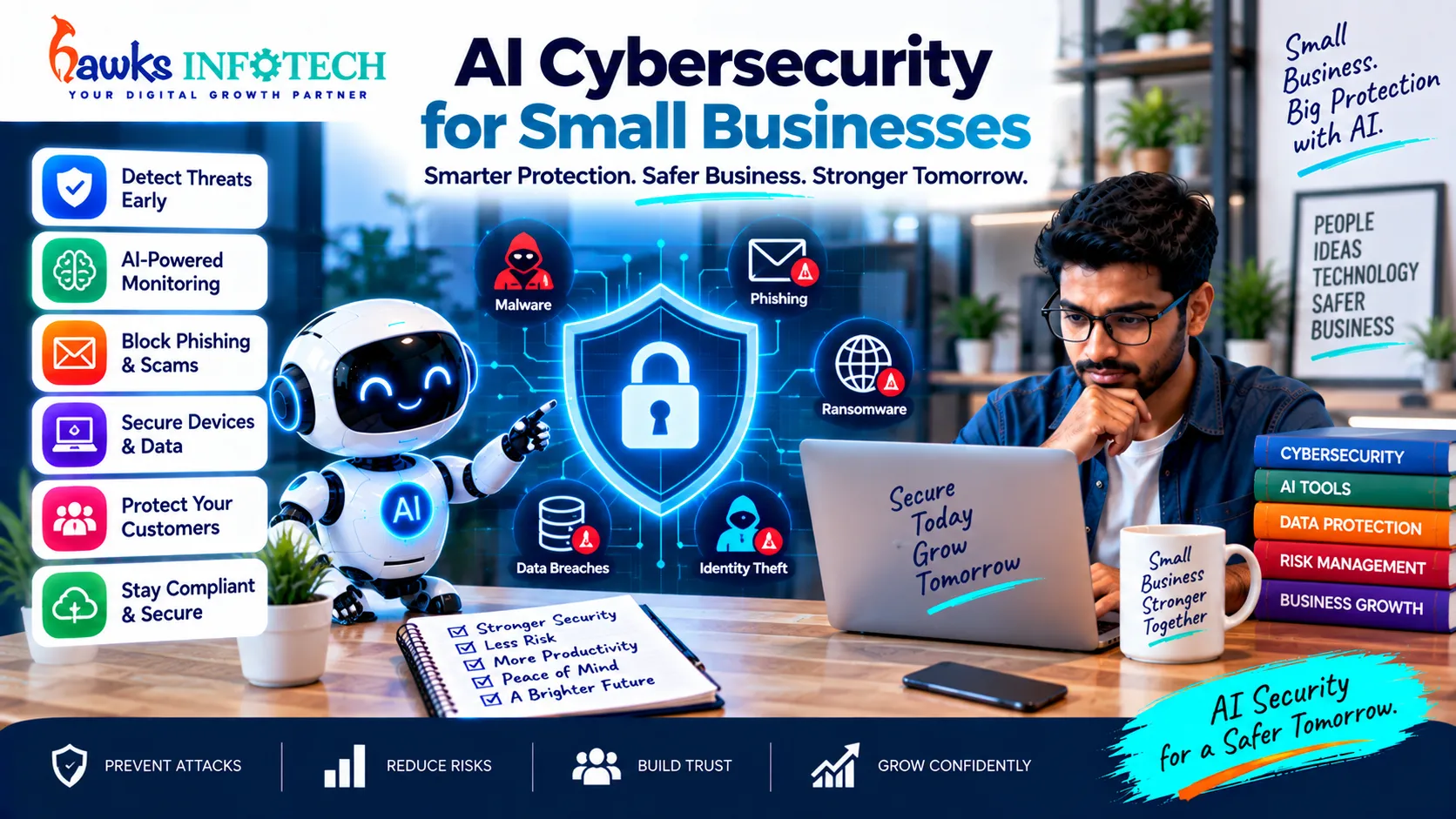
There is a dangerous myth circulating among small business owners: "Our company is too small to be a target for cybercriminals." In 2026, the harsh reality is that small and mid-sized enterprises (SMBs) represent over 60% of all automated ransomware and cyber fraud victims. Threat actors do not handpick targets by company prestige; automated AI bots crawl the web continuously, targeting any unprotected network with open ports, unpatched software, or vulnerable employee credentials.
The SMB Risk Reality
The average cost of an unmitigated ransomware attack on an SMB in 2026 exceeds $140,000 in operational downtime, forensic recovery fees, and lost customer trust.
The AI Equalizer
Cloud-delivered AI security tools allow a 15-person company to achieve the continuous 24/7 endpoint protection previously reserved for multinational banks.
Supporting Deep-Dive Guide
Master Pillar: AI-Powered Cybersecurity Threats in 2026
Table of Contents
Direct Answer: How can small businesses implement AI cybersecurity affordably?
Small businesses can build comprehensive AI cybersecurity by: 1) Replacing legacy antivirus with behavioral Endpoint Detection and Response (EDR), 2) Enforcing multi-factor authentication across all cloud accounts, 3) Implementing automated air-gapped immutable cloud backups, 4) Partnering with a managed provider for AI-powered IT support, and 5) Conducting regular employee phishing simulation drills.
1. The Changing Threat Profile for Small Businesses in 2026
In previous decades, small businesses could fly under the radar simply because human hackers did not bother wasting manual effort on companies with modest bank accounts.
In 2026, artificial intelligence has reduced the cost of launching cyberattacks to near zero. Autonomous bots scan entire geographic IP subnets across Delhi NCR, Mumbai, and tier-2 business clusters, detecting unpatched firewall routers and weak employee passwords in seconds.
For a deep look into the mechanics behind these automated attacks, explore our companion reports on AI-powered cybersecurity threats and how hackers use AI in 2026.
2. The 4 Essential Pillars of SMB AI Defense
1. Endpoint Behavioral Telemetry
Monitors every workstation and laptop continuously, detecting unusual process execution, unauthorized registry tampering, or sudden bulk file renames indicative of ransomware.
2. Air-Gapped Immutable Backups
Encrypted snapshots stored in write-once-read-many (WORM) cloud repositories that cannot be deleted or modified, even if an attacker gains root administrative credentials.
3. Contextual Email Defense
Natural language analysis filters that examine incoming emails for linguistic deception, vendor invoice fraud, and quishing (QR code) vectors.
4. Zero-Trust Access Control
Eliminates shared passwords and enforces strict role-based access permissions, ensuring employees only access the specific databases required for their job function.
3. Behavioral Endpoint Detection vs Traditional Antivirus
Many small business owners assume their computers are safe because they installed a basic antivirus program three years ago. However, traditional antivirus relies on known file signatures:
- AI malware mutates its cryptographic signature upon every infected host, slipping right past legacy signature scanners.
- Modern Endpoint Detection and Response (EDR) evaluates behavior: if a spreadsheet file suddenly launches command-line utilities and begins encrypting folders, EDR terminates the process instantly and isolates the device from the network.
4. Immutable Cloud Backups: The Ultimate Ransomware Antidote
Ransomware syndicates deliberately target local backup hard drives before encrypting the main database. If your backups are plugged directly into your office server, the ransomware will encrypt them simultaneously.
An immutable cloud backup operates on strict write-once rules. Once uploaded, the backup snapshot cannot be altered, overwritten, or purged for a set retention window (e.g. 30 days). Even in a worst-case total network breach, your systems can be completely restored within hours without paying a single rupee in ransom.
5. Building an Affordable Security Stack for Under $100/Month
6. The 7-Step Small Business Security Checklist
- Enable Multi-Factor Authentication (MFA): Mandate MFA across all email, banking, accounting, and cloud hosting portals.
- Decommission Dormant User Accounts: Immediately revoke access for former employees, contractors, and temporary interns.
- Segment Office Guest Wi-Fi: Ensure visitors and mobile phones connect to an isolated guest network separate from company workstations.
- Automate OS & Patch Updates: Enforce mandatory weekly operating system and software patch updates across all endpoints.
- Conduct Quarterly Phishing Drills: Train staff to recognize deceptive prompts, as outlined in our guide on protecting employees from AI phishing.
- Audit Sensitive File Permissions: Restrict financial spreadsheets and customer PII so only authorized managers have access.
- Establish an Incident Response Playbook: Maintain clear written protocols on who to call and how to isolate systems during a breach.
7. Frequently Asked Questions
Can a small business survive a ransomware attack without paying the ransom?
Yes, provided the business maintains verified, immutable off-site backups. Paying the ransom is never recommended because cybercrime syndicates often fail to deliver decryption keys or demand secondary extortion payments.
Does cyber insurance cover losses from AI phishing and fraud?
Modern cyber insurance policies increasingly require evidence of strict technical controls (such as active EDR, universal MFA, and regular backups) before paying out claims. If a company fails to maintain these basic hygiene standards, claims are frequently denied.
How do I know if our office network is currently compromised?
Signs of compromise include sluggish computer performance, unprompted password reset notifications, unknown background network traffic spikes, and disabled security tools. A professional security audit can detect hidden persistence mechanisms within 24 hours.
Topical Cluster: AI-Powered Cybersecurity & Threat Defense
Explore the complete interconnected network of pillar guides and specialized deep-dive articles in this domain:

AI-Powered Cybersecurity Threats in 2026
Explore the comprehensive master guide that unifies all AI-Powered Cybersecurity & Threat Defense strategies.


