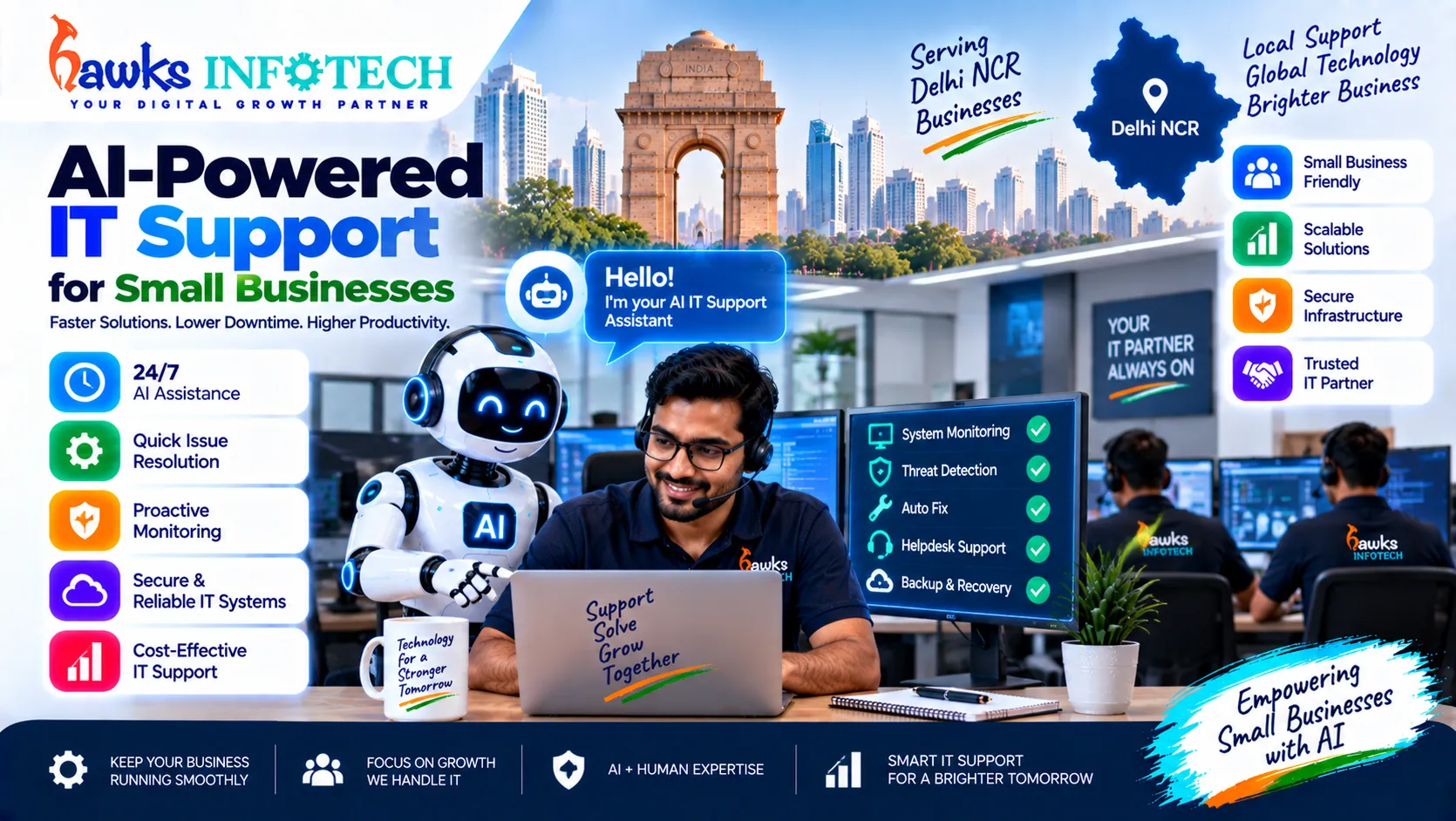
For decades, small business IT support operated under an obsolete "break-fix" model: an office workstation freezes, an internet router fails, or an accounting server crashes, and the business owner frantically phones a local technician while employees sit idle for hours. In 2026, AI-powered IT support has replaced reactive panic with autonomous, predictive reliability—diagnosing hardware failures weeks before they happen, self-healing network drops in seconds, and providing 24/7 helpdesk resolution without human delays.
Predictive Maintenance
Analyzes disk sector telemetry, thermal readings, and RAM errors to identify failing components days before a catastrophic system crash occurs.
Autonomous Security
Detects suspicious ransomware encryption attempts in real time, automatically isolating infected endpoints from the office network in 200 milliseconds.
Supporting Deep-Dive Guide
Master Pillar: How Small Businesses Can Use AI in 2026
Table of Contents
Direct Answer: What is AI-powered IT support?
AI-powered IT support combines lightweight endpoint telemetry agents with machine learning models to monitor, diagnose, and remediate computer, server, and network issues proactively. Rather than waiting for systems to fail, AI identifies hardware anomalies, automates security patch deployment, resolves common software tickets instantly, and schedules field technician repairs before outages disrupt business operations.
1. The Shift from Reactive Helpdesks to Autonomous IT Management
Traditional IT outsourcing suffered from severe structural misalignments: service providers were paid when things broke, creating little economic incentive for long-term preventive hygiene.
In 2026, modern Managed Service Providers (MSPs) operate under an AI-first paradigm. Advanced diagnostic algorithms run continuous background audits across all connected laptops, desktop workstations, cloud servers, and network switches. Over 70% of potential IT incidents are identified and remediated autonomously in the background without the employee ever experiencing a slowdown.
This technological foundation enables the broader operational automations explored in our guide on AI automation ideas for small businesses and powers enterprise operations in Delhi NCR businesses.
2. Predictive Hardware Diagnostics & Thermal Telemetry
Computer hardware rarely fails without early warning signs. In 2026, AI telemetry monitors subtle operational metrics:
- NVMe SSD & Hard Drive SMART Data: Neural models analyze read/write error retry patterns, warning IT engineers that a drive has a 94% probability of failure within 14 days.
- Battery Swell & Thermal Degradation: Machine learning algorithms monitor laptop charging curves and CPU thermal spikes, flagging laptops that require cooling fan cleaning or battery replacement before motherboard damage occurs.
- Memory Leaks & System Crash Logs: Detects repetitive kernel exceptions and background driver conflicts before they cause blue-screen crashes.
3. Self-Healing Networks & Cloud Failovers
Office Wi-Fi and network connectivity represent the lifeblood of modern commerce. When an internet provider suffers packet loss or latency spikes, AI network controllers take instantaneous corrective action:
Dual-WAN Failover
Reroutes active voice and video traffic to backup cellular or fiber connections in under 50ms without disconnecting active calls.
Bandwidth Throttling
Identifies rogue devices consuming excessive bandwidth on non-business tasks, prioritizing CRM, billing, and VoIP packets.
Automated DNS Healing
Switches primary DNS servers automatically if upstream resolvers experience global outages or poisoning attacks.
4. 24/7 AI-Assisted Employee Helpdesk
When an employee encounters a technical barrier ("How do I connect to the office VPN?", "My printer is showing offline"), opening a ticket and waiting four hours for human triage severely degrades productivity.
Integrated IT helpdesk bots deployed inside Microsoft Teams or Slack converse directly with staff members:
- They guide the user through step-by-step interactive troubleshooting cards with annotated screenshots.
- They can execute safe remote diagnostic scripts (restarting print spoolers, clearing corrupted browser caches) upon user authorization.
- If hardware repair is required, the bot automatically books an on-site engineer visit with full diagnostic logs pre-attached.
All automated remote diagnostic interventions operate through TLS 1.3 encrypted tunnel sessions with multi-factor biometric confirmation. This guarantees that remote troubleshooting maintains strict compliance with enterprise data privacy standards while resolving 85% of common workstation issues in under four minutes.
5. Integrating Cybersecurity Defense at the Endpoint
IT support and cybersecurity can no longer be treated as separate silos. As examined in our analyses of AI-powered cybersecurity threats and AI cybersecurity for small businesses, hackers deploy automated scripts targeting SMB workstations.
Modern AI IT support packages incorporate Endpoint Detection and Response (EDR) that continually scans file executions, blocks credential dumping attacks, and verifies that operating system security patches are applied across all company devices.
| Support Tier | Autonomous Remediation | Remote Helpdesk SLA | On-Site Dispatch SLA |
|---|---|---|---|
| Standard AMC | Antivirus updates & disk cleanup | Under 60 minutes | Next business day |
| Proactive Enterprise | Self-healing network & thermal alerts | Under 15 minutes | Under 4 hours (Delhi NCR) |
| Mission-Critical Server | Instant VM container failover | Immediate 24/7 hotline | Under 2 hours dedicated engineer |
6. The Complete Managed IT Support Checklist for SMBs
-
24/7 Predictive Telemetry: Continuous monitoring of workstation SSDs, CPU thermals, and RAM integrity.
-
Automated Immutable Cloud Backups: Daily encrypted snapshots of critical servers with automated quarterly restore simulations.
-
AI-Driven Endpoint Security: Real-time behavioral antivirus blocking zero-day exploits and malicious phishing payloads.
-
Guaranteed Rapid On-Site Response: Certified technicians available for emergency on-premises hardware replacement within 4 hours.
7. Frequently Asked Questions
Can AI-powered IT support replace our in-house systems administrator?
For small businesses with under 100 employees, managed AI IT support eliminates the need for expensive in-house IT headcount, providing enterprise-grade 24/7 monitoring at a fraction of the cost of a single full-time employee salary.
How does remote predictive monitoring affect employee privacy?
Enterprise monitoring agents track hardware performance metrics (temperature, disk health, memory utilization, network traffic volume) and security flags. They do not record keystrokes, view personal files, or monitor screen activity without explicit employee authorization.
What is the typical response time for critical server outages?
Automated cloud failover and remote diagnostic scripts execute within 60 seconds. If physical hardware replacement is required, on-site emergency technician response SLAs typically guarantee dispatch within 2 to 4 hours across major metro hubs.
Topical Cluster: AI Tools & Small Business Automation
Explore the complete interconnected network of pillar guides and specialized deep-dive articles in this domain:

How Small Businesses Can Use AI in 2026
Explore the comprehensive master guide that unifies all AI Tools & Small Business Automation strategies.


