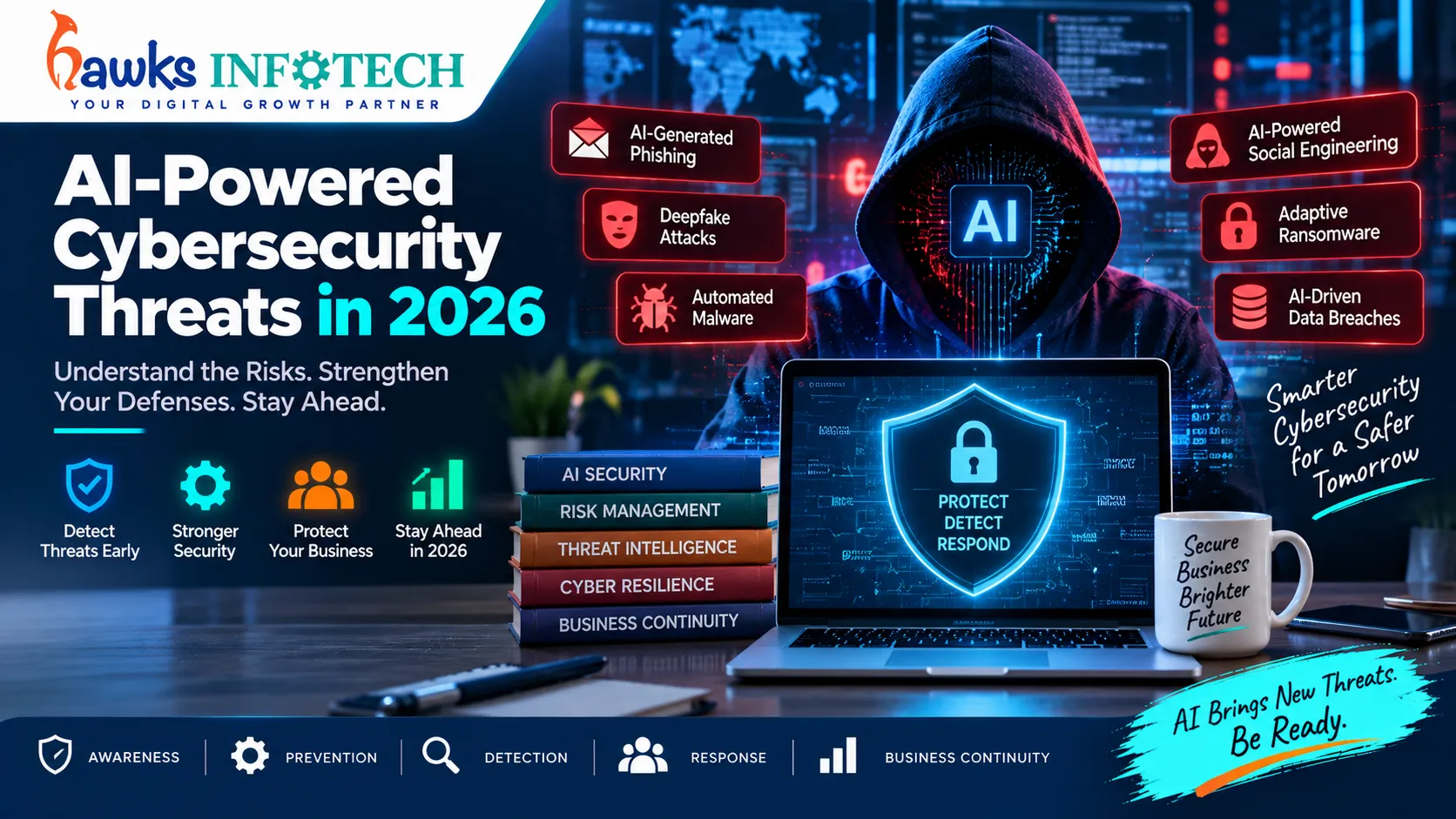
The cybersecurity paradigm has officially entered the era of machine-speed warfare. In 2026, corporate networks are no longer attacked solely by human hackers manually probing open ports after hours. Today, threat actors deploy autonomous artificial intelligence agents capable of scanning millions of internet-connected IP addresses simultaneously, synthesizing tailored spear-phishing messages within seconds, and rewriting executable malware payloads on the fly to bypass signature-based antivirus software.
The Offense Shift
Automated malware adapts its cryptographic hashing every time it hops between network hosts, rendering conventional perimeter firewalls virtually blind.
Defense Requirement
Organizations must fight AI with AI—deploying autonomous endpoint telemetry that detects anomalous behavior in milliseconds rather than relying on reactive human alerts.
AI-Powered Cybersecurity & Threat Defense
Comprehensive authority resource connecting all specialized sub-guides and actionable execution frameworks.
Table of Contents
Direct Answer: What are the primary AI-powered cybersecurity threats in 2026?
The most dangerous AI cybersecurity threats in 2026 include: 1) Polymorphic malware that mutates its binary code to evade endpoint detection, 2) Autonomous exploit bots that chain together minor system misconfigurations in seconds, 3) Real-time deepfake voice cloning for wire fraud, 4) Hyper-personalized spear-phishing without grammatical flaws, and 5) Automated credential spraying across cloud APIs.
1. The State of AI Cyber Warfare in 2026: Speed, Scale, & Precision
Historically, cyberattacks involved a trade-off between scale and personalization. Mass phishing campaigns were broad, generic, and easily caught by spam filters ("Dear Sir, I have a million dollar inheritance"). Targeted attacks (spear-phishing), on the other hand, required days of manual intelligence gathering by skilled adversaries.
In 2026, artificial intelligence has dissolved this trade-off. Automated large language model agents scrape public LinkedIn posts, corporate press releases, conference attendee rosters, and GitHub commits. Within minutes, the AI generates thousands of unique, flawless spear-phishing emails customized for specific employees.
To understand how employees can recognize these machine-generated decoys, review our deep dive on AI-powered phishing and employee protection and examine our tactical guide on how hackers are using AI in 2026.
2. Polymorphic Malware & Autonomous Exploitation
Traditional antivirus software operates by maintaining a database of known file hashes (digital fingerprints). When a file downloads, the antivirus compares the hash against its blacklist.
Modern threat syndicates deploy AI-driven polymorphic ransomware. Utilizing localized neural networks embedded within the loader, the executable alters its encryption routines, modifies variable names, and injects junk assembly instructions every time it copies itself:
- The digital SHA-256 hash changes continuously, rendering traditional signature blacklists useless.
- The malware executes in-memory sleep states when it detects dynamic sandbox environments, activating only when real human user interaction is confirmed.
- Once inside an enterprise subnet, autonomous lateral movement agents probe domain controllers, stealing active Kerberos tickets in seconds.
3. Generative Social Engineering & Deepfake Deception
The human element remains the most vulnerable perimeter. In 2026, threat actors combine conversational audio synthesis with real-time video manipulation to orchestrate unprecedented fraud:
Real-Time AI Voice Cloning
Adversaries clone a Managing Director's voice using a 5-second public speech sample, phoning accounting staff to approve urgent vendor wire transfers. Explore countermeasures in AI voice scams and business security.
Video Conference Impersonation
Deepfake video streams simulate high-level executives on Microsoft Teams or Zoom meetings to authorize multi-million dollar banking transactions. Learn more in deepfake fraud and Indian businesses.
4. Automated Credential Stuffing & API Hijacking
Public cloud APIs and remote desktop gateways face non-stop machine bombardment. Instead of basic brute-force scripts that trigger rate-limiting firewalls, AI credential bots:
- Rotate between 50,000 residential proxy IP addresses to mimic authentic localized user traffic.
- Mimic human typing cadence, mouse jitter, and hesitation curves to bypass traditional CAPTCHA challenges.
- Correlate breached password fragments with employee social profiles to predict customized enterprise password combinations.
5. Enterprise AI Defense: Behavioral EDR & Zero Trust Architecture
To neutralize AI-driven cyber threats, defensive architectures must eliminate implicit trust. Organizations in 2026 deploy Zero Trust Network Access (ZTNA) paired with behavioral Endpoint Detection and Response (EDR):
Behavioral Anomaly Detected:
  Process 'excel.exe' spawned unexpected child process 'powershell.exe'
  Attempting memory injection into 'lsass.exe'
  ↓ [Autonomous AI Security Trigger: 180 Milliseconds]
Isolate Endpoint from Local Subnet
Revoke Active Kerberos & OAuth Session Tokens
Terminate Child Process Thread
Notify Managed SOC Incident Commander
For small businesses evaluating defense options, consult our roadmap on AI cybersecurity for small businesses.
6. The 5-Point Security Hardening Checklist
- 1. Enforce Phishing-Resistant MFA: Mandate hardware FIDO2 security keys or device-bound passkeys instead of SMS OTPs or app push notifications.
- 2. Out-of-Band Financial Verification: Require dual-person verbal confirmation via secondary phone lines for any wire transfer exceeding predetermined thresholds.
- 3. Deploy Behavioral Endpoint Telemetry: Upgrade legacy antivirus suites to modern EDR agents that monitor runtime memory activity.
- 4. Continuous Employee Simulation Drills: Test staff regularly with simulated AI spear-phishing messages to build active institutional skepticism.
- 5. Immutable Offline Cloud Backups: Maintain air-gapped, immutable database snapshots that cannot be encrypted even if domain admin credentials are compromised.
7. Frequently Asked Questions
Can traditional antivirus software stop AI-generated malware?
No. Traditional antivirus relies on known file signatures. AI malware mutates its hash upon every execution, rendering static signatures ineffective. Defense requires behavioral EDR software that detects malicious actions (such as unauthorized file encryption or registry modification) regardless of the file's hash.
Are small businesses really targeted by advanced AI cyber attacks?
Yes. Cybercrime syndicates use automated AI bots to scan the entire IPv4 web space indiscriminately. Small and medium businesses are frequently targeted because they maintain valuable customer records and bank accounts but often lack dedicated cybersecurity teams.
What is the single most effective defense against deepfake voice fraud?
Strict out-of-band operational verification protocols. Establish an immutable company policy requiring accounting staff to independently call back the executive on a pre-verified private mobile number or verify with an in-person verbal passphrase before releasing wire funds.
Topical Cluster: AI-Powered Cybersecurity & Threat Defense
Explore the complete interconnected network of pillar guides and specialized deep-dive articles in this domain:


