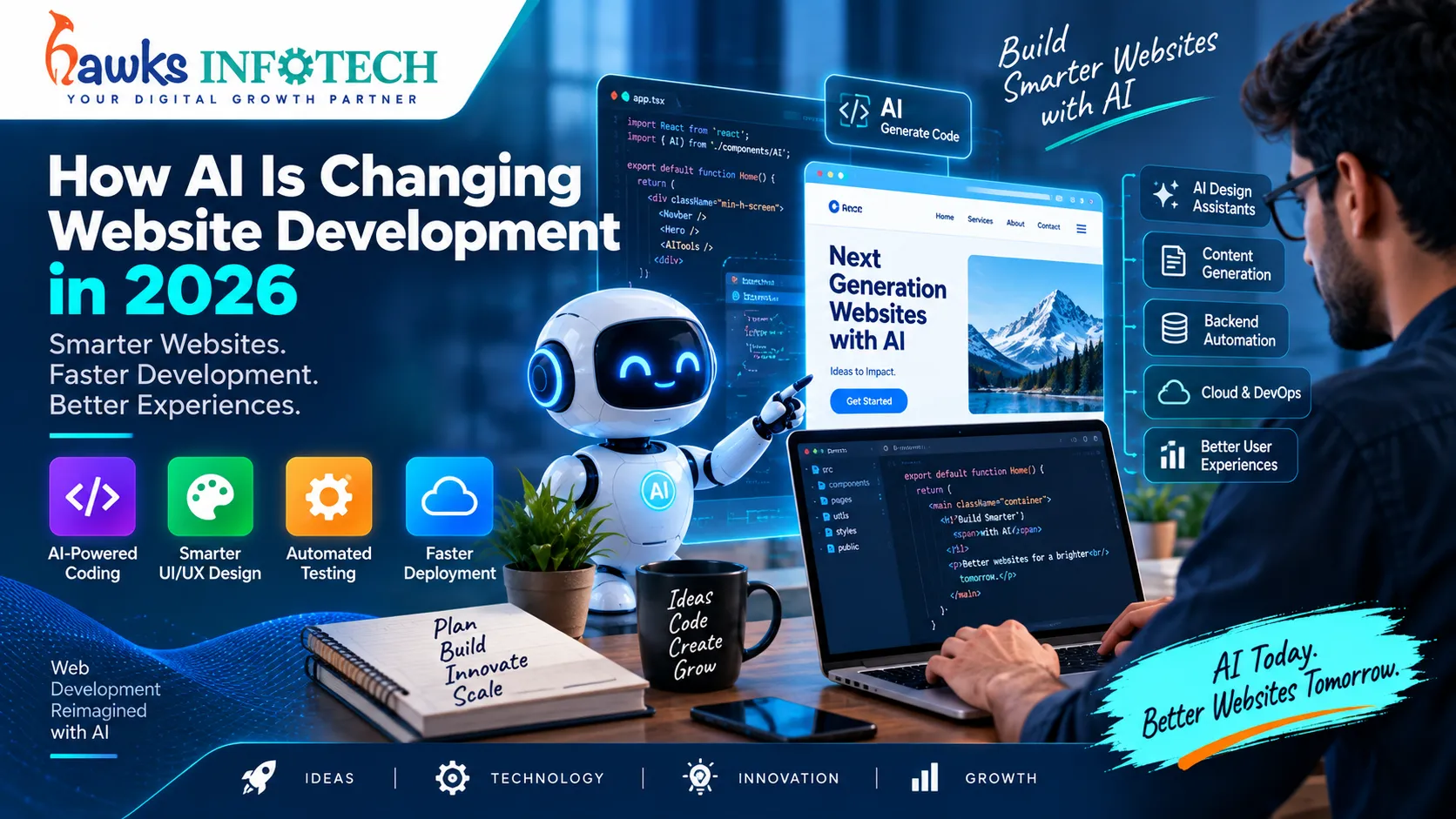
Web development is experiencing its most seismic paradigm shift since the advent of responsive mobile design. In 2026, building an enterprise website no longer entails writing thousands of boilerplate lines of HTML, CSS, and database connections by hand. Modern software engineering teams leverage artificial intelligence across every layer of the web lifecycle—from autonomous UI scaffolding and dynamic hyper-personalization to predictive performance tuning and automated security auditing.
Engineering Shift
Developers have evolved from manual syntax typists to software system architects who orchestrate AI code generators, validate business logic, and harden security.
Business Velocity
Feature development cycles that previously required 12 weeks are now deployed in 14 days, allowing businesses to iterate rapidly while maintaining clean codebases.
AI Website Development & Engineering
Comprehensive authority resource connecting all specialized sub-guides and actionable execution frameworks.
Table of Contents
Direct Answer: How is AI changing web development in 2026?
In 2026, AI accelerates development velocity by 300% through automated code scaffolding, instant design-to-code compilation, predictive caching, and continuous security regression testing. However, raw AI cannot replace custom business architecture, database integrity, and brand originality. Modern success relies on combining AI tooling with custom website development and human architectural oversight.
1. The State of Web Engineering in 2026: Beyond Simple Templates
Just as AI has transformed search engine visibility—as detailed in our guide on how AI is changing SEO in 2026—it has equally revolutionized how digital platforms are architected. Early fears that artificial intelligence would render professional software engineers obsolete have proved unfounded.
Instead, AI has eliminated tedious mechanical programming. Developers no longer spend hours writing CRUD (Create, Read, Update, Delete) endpoints, repetitive form validation handlers, or CSS media queries. Instead, specialized AI models generate functional code scaffolding in seconds, allowing developers to focus on high-impact challenges: system architecture, API latency, compliance, and user conversion psychology.
Business leaders must understand the crucial distinction between automated templating and custom engineering. For an in-depth cost and capability analysis, review our comparison between an AI website builder vs professional web developer.
2. Autonomous UI Scaffolding & Design-to-Code Compilation
One of the most profound breakthroughs in 2026 is multimodal design-to-code compilation. Development teams can upload high-fidelity Figma design files, UI wireframes, or hand-drawn sketches directly into development environments.
Neural networks parse the visual components, recognize UI patterns (navigation headers, carousel cards, testimonial grids), and autonomously output clean, production-grade semantic HTML, Tailwind CSS, or React/Vue components. This workflow:
- Eliminates weeks of tedious front-end slice-and-dice work.
- Maintains exact typographic and color consistency with the brand design tokens.
- Enforces accessible semantic tags (
<header>,<main>,<article>) required by AI search engines and crawlers.
3. Real-Time Dynamic Personalization Engines
In the past, every visitor to a corporate website viewed the exact same static landing page regardless of their industry, geographic origin, or purchase intent. In 2026, AI-driven websites adapt their layout dynamically in real time.
When a healthcare CIO lands on your technology site, the AI personalization layer reconfigures the hero headline to highlight HIPAA compliance and medical data security. When an e-commerce retailer visits five minutes later, the exact same URL dynamically highlights high-volume inventory sync and payment gateway reliability. This contextual adaptation increases visitor-to-lead conversion rates by up to 42%.
4. Predictive Performance & Core Web Vitals Optimization
Website speed is no longer just a technical luxury—it is a vital search ranking factor and conversion driver. In 2026, web developers deploy predictive AI algorithms directly within Content Delivery Networks (CDNs) and edge servers:
Predictive Asset Prefetching
AI monitors cursor movement and hover states to prefetch the next page resources 300ms before the user actually clicks.
Adaptive Media Compression
Dynamic encoders evaluate the visitor's device screen resolution and cellular bandwidth to serve perfectly sized WebP and AVIF assets.
Dead Code Pruning
Automated build tools identify and tree-shake unused JavaScript scripts, ensuring sub-100ms Time to Interactive (TTI).
5. Automated Security Hardening & Vulnerability Scans
Cybercriminals in 2026 deploy automated scripts to probe websites for zero-day vulnerabilities, outdated plugins, and misconfigured API endpoints. To defend enterprise applications, web engineering teams embed continuous AI security auditors into continuous integration (CI/CD) pipelines.
These automated guardians detect SQL injection vectors, enforce strict Content Security Policies (CSP), and flag cross-site scripting (XSS) risks before pull requests ever merge into production. Discover how modern development tools streamline this process in our guide on AI coding tools for web developers.
6. The Rise of the AI-Augmented Web Engineer
The modern software developer in 2026 is a force multiplier. Instead of managing a team of ten junior coders, a senior lead engineer utilizes automated copilots to achieve equivalent output. The developer's primary responsibilities now include:
- System Design & Database Architecture: Ensuring relational tables, vector stores, and caching layers are normalized for horizontal scalability.
- Custom Business Logic Verification: Verifying that automated algorithms accurately reflect proprietary enterprise calculations, taxation rules, and client workflows.
- CMS Modernization: Integrating intelligent workflows across content management systems, as outlined in our breakdown of AI-powered WordPress development.
- Quality Assurance & Ethical Compliance: Auditing code for bias, accessibility compliance (WCAG 2.2), and regional data sovereignty regulations.
7. Frequently Asked Questions
Will AI completely replace human web developers by 2030?
No. AI excels at syntax completion and boilerplate scaffolding, but it cannot negotiate stakeholder trade-offs, solve novel architectural bottlenecks, or understand company brand emotion. Developers who master AI tools will replace developers who refuse to adopt them.
Are websites built with AI secure against hackers?
Code generated by raw AI models often contains hallucinated library dependencies and insecure default permissions. Production web applications require thorough review and hardening by experienced software engineers before deployment.
How does AI-driven development impact project delivery timelines?
By eliminating manual boilerplate programming, AI tools typically reduce delivery timelines for custom web development projects by 40% to 60%, enabling faster time-to-market and lower total development costs.
Topical Cluster: AI Website Development & Engineering
Explore the complete interconnected network of pillar guides and specialized deep-dive articles in this domain:


