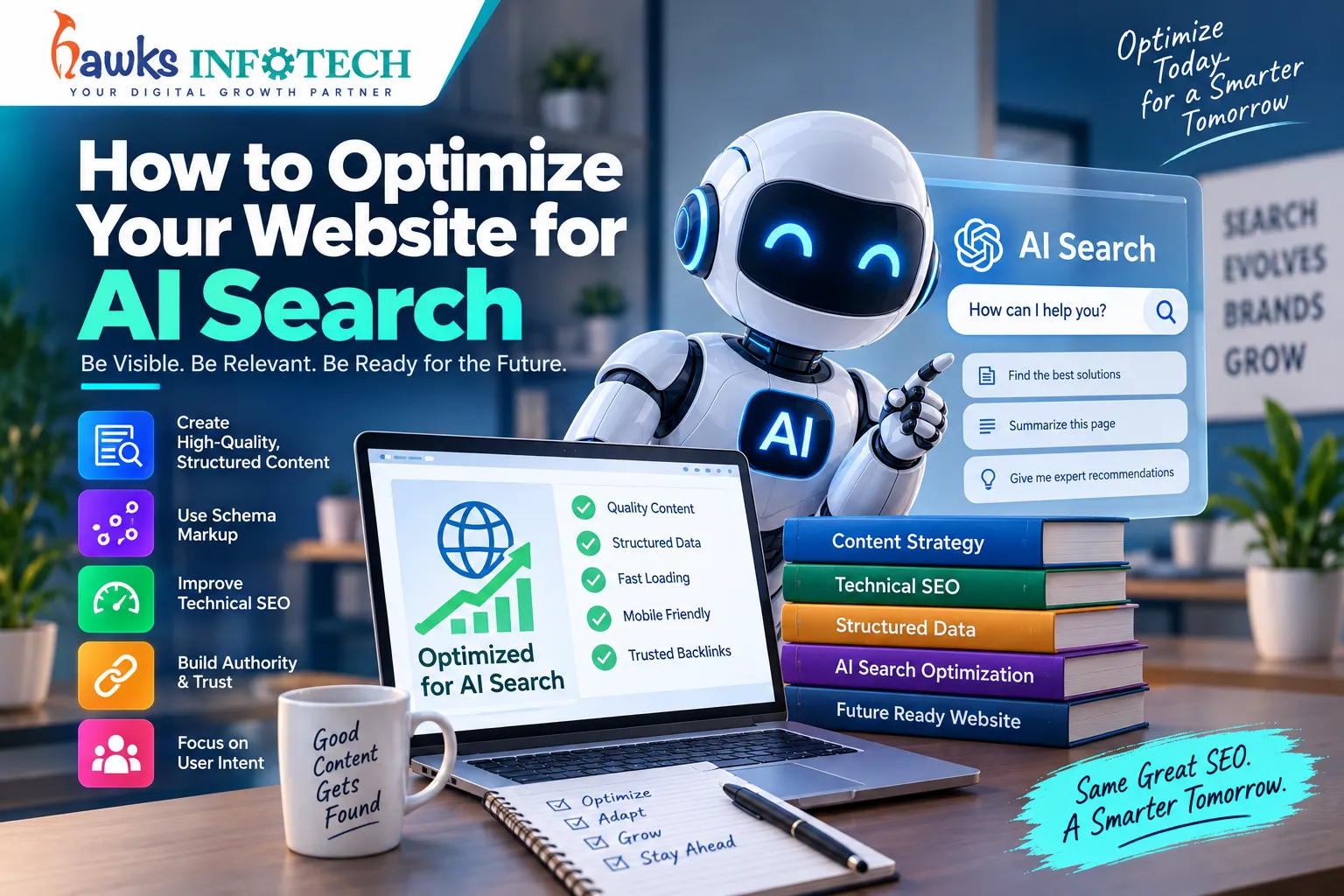
As established in our comprehensive analysis of how AI is changing SEO in 2026, algorithmic search has transitioned from ranking blue hyperlinks to answering user prompts with synthesized summaries. Optimizing your website for AI search engines—including Google AI Overviews, Perplexity, and ChatGPT Search—requires a fundamentally different tactical playbook than legacy SEO.
Technical Scope
Covers crawl permissions for AI user agents, server latency tuning, headless CMS structuring, semantic HTML markup, and microdata entity linking.
Key Outcome
Transform your static web pages into machine-readable knowledge nodes that LLMs seamlessly ingest, verify, and cite as trusted authoritative answers.
Supporting Deep-Dive Guide
Master Pillar: How AI Is Changing SEO in 2026
Table of Contents
Direct Answer: What are the main steps to optimize for AI search?
To optimize your website for AI search engines, you must: 1) Allow AI bots (GPTBot, ClaudeBot, PerplexityBot) in your robots.txt, 2) Format answers using atomic sentence structures and clear comparison tables, 3) Implement rich JSON-LD schema linking entities to authoritative knowledge bases, 4) Maintain sub-second load times via modern web development, and 5) Master Generative Engine Optimization (GEO) frameworks.
1. Understanding the LLM Retrieval Pipeline: How AI Bots Read Your Site
Traditional search engines employ web crawlers that parse HTML, build inverted index tables, and calculate PageRank. Modern AI search platforms, however, utilize a sophisticated multi-stage retrieval architecture known as Retrieval-Augmented Generation (RAG).
When a user poses a question in ChatGPT Search or Google, the system executes four simultaneous steps:
- Query Expansion: Breaking the prompt down into semantic sub-queries.
- Candidate Retrieval: Scraping top-ranking documents from both traditional indexes and cached vector databases.
- Passage Re-ranking & Chunk Extraction: Splitting web pages into semantic text chunks (usually 200–500 tokens) and scoring them for factual relevance.
- Synthesis & Citation: Generating the final answer while attaching attribution hyperlinks to the highest-scoring candidate chunks.
If your web pages consist of sprawling, vague marketing jargon, the retrieval model will discard your text chunks in favor of a competitor who states clear facts with unambiguous phrasing. For deeper insights into this mechanism, see our analysis of Google AI Overviews and SEO.
2. Technical AI Crawlability & Permissions: Robots.txt & Server Performance
The most beautifully written content cannot be cited if AI crawlers are blocked at the perimeter. In 2026, webmasters must explicitly configure their crawl policies to welcome AI user agents while safeguarding proprietary server assets.
# Recommended robots.txt configuration for AI Search Engines
User-agent: Googlebot
Allow: /

User-agent: Google-Extended
Allow: /

User-agent: GPTBot
Allow: /

User-agent: ClaudeBot
Allow: /

User-agent: PerplexityBot
Allow: /

# Prevent scrapers from exhausting compute on search filters
Disallow: /*?sort=*
Disallow: /*?filter=*
Additionally, LLM crawlers enforce aggressive timeout thresholds (typically 1.5 to 2.5 seconds). If your server takes 800ms to deliver Time-to-First-Byte (TTFB) or relies heavily on client-side JavaScript rendering, AI bots will skip your content entirely. Pairing clean backend code with custom website development is non-negotiable.
3. Content Structuring: Atomic Q&A, Comparison Tables, & Verifiable Facts
AI models are designed to minimize token consumption and maximize factual certainty. To get your content selected for synthesis:
- Adopt the Inverted Pyramid Style: Place the definitive answer in the first 40–60 words directly beneath every H2 heading. Follow up with nuances, examples, and edge cases.
- Format Key Metrics into HTML Tables: AI models parse HTML `<table>` structures with exceptionally high precision compared to comma-separated text lists.
- Use Unambiguous Pronouns: Instead of writing "It provides superior protection," write "Managed firewall solutions provide superior protection against zero-day exploits." Clear entity references reduce LLM parsing ambiguity.
- Integrate Direct Quote Blocks: Attribute opinions directly to recognized experts using semantic `<blockquote>` tags. Learn more about citation optimization in how to get your business mentioned in AI search results.
4. Implementing Deep JSON-LD Entity Graph Schema
Schema markup is the ultimate bridge between human readability and machine comprehension. Basic schemas (`WebPage`, `BlogPosting`) are no longer sufficient. In 2026, enterprise websites deploy nested entity schemas connecting the organization, founders, core offerings, and authoritative Wikidata/Wikipedia topics:
{
  "@context": "https://schema.org",
  "@type": "TechArticle",
  "headline": "How to Optimize Your Website for AI Search",
  "about": [
    {"@type": "Thing", "name": "Generative Artificial Intelligence", "sameAs": "https://en.wikipedia.org/wiki/Generative_artificial_intelligence"},
    {"@type": "Thing", "name": "Search Engine Optimization", "sameAs": "https://en.wikipedia.org/wiki/Search_engine_optimization"}
  ],
  "mentions": [
    {"@type": "Organization", "name": "Google", "sameAs": "https://en.wikipedia.org/wiki/Google"},
    {"@type": "Organization", "name": "OpenAI", "sameAs": "https://en.wikipedia.org/wiki/OpenAI"}
  ]
}
5. Speed, Clean Code & Modern Web Development
Bloated, plugin-heavy websites struggle in the AI search era. Because AI bots scrape millions of web pages continuously, their crawlers heavily favor streamlined HTML DOM trees. Removing excessive render-blocking CSS, eliminating unused JavaScript scripts, and adopting clean server-rendered architectures dramatically improves AI crawl efficiency.
Businesses upgrading their digital presence should partner with specialized engineering teams who understand both performance optimization and algorithmic search. Explore our dedicated custom web development services and professional SEO solutions to ensure your infrastructure exceeds all modern speed and markup benchmarks.
6. The 6-Step AI Optimization Checklist
-
Step 1: AI Bot Permissions: Verify that GPTBot, ClaudeBot, and PerplexityBot are unblocked in your server firewall and robots.txt.
-
Step 2: Micro-Answer Formatting: Structure every H2 section with a concise 50-word direct summary immediately below the header.
-
Step 3: Tabular Summaries: Convert complex comparative data into clean semantic HTML tables.
-
Step 4: Structured Entity Schemas: Connect your brand and key concepts with `sameAs` links to authoritative Wikidata records.
-
Step 5: High-Speed Server Delivery: Keep server response times below 200ms and eliminate heavy render-blocking scripts.
-
Step 6: Continuous Entity Mentions: Build credible co-citations and expert reviews across high-authority digital publications.
7. Frequently Asked Questions
Can AI search engines index dynamic single-page applications (SPAs)?
While advanced search crawlers can execute client-side JavaScript, doing so requires substantial compute resources. For AI bots scraping pages during real-time retrieval-augmented generation (RAG), server-side rendered (SSR) or statically generated HTML is far more reliably indexed and cited than pure client-side JavaScript applications.
How quickly can a website earn citations in ChatGPT or Google AI Overviews?
Websites that implement direct answer cards, high information-gain research, and valid JSON-LD schemas often see citations appear in real-time search platforms (like Perplexity and ChatGPT Search) within 7 to 21 days of indexation.
Does optimizing for AI search hurt my traditional Google rankings?
Quite the opposite. AI search optimization enforces faster load times, superior semantic clarity, richer structured data, and stronger information gain—all of which are core signals that improve traditional organic search rankings as well.
Topical Cluster: AI Search & Generative Engine Optimization (GEO)
Explore the complete interconnected network of pillar guides and specialized deep-dive articles in this domain:

How AI Is Changing SEO in 2026
Explore the comprehensive master guide that unifies all AI Search & Generative Engine Optimization (GEO) strategies.
How AI Is Changing SEO in 2026

Generative Engine Optimization (GEO): Complete Guide

Google AI Overviews and SEO

ChatGPT Search and the Future of SEO

AI SEO Tools for Businesses

AI vs Human Content: Which Is Better for SEO?
