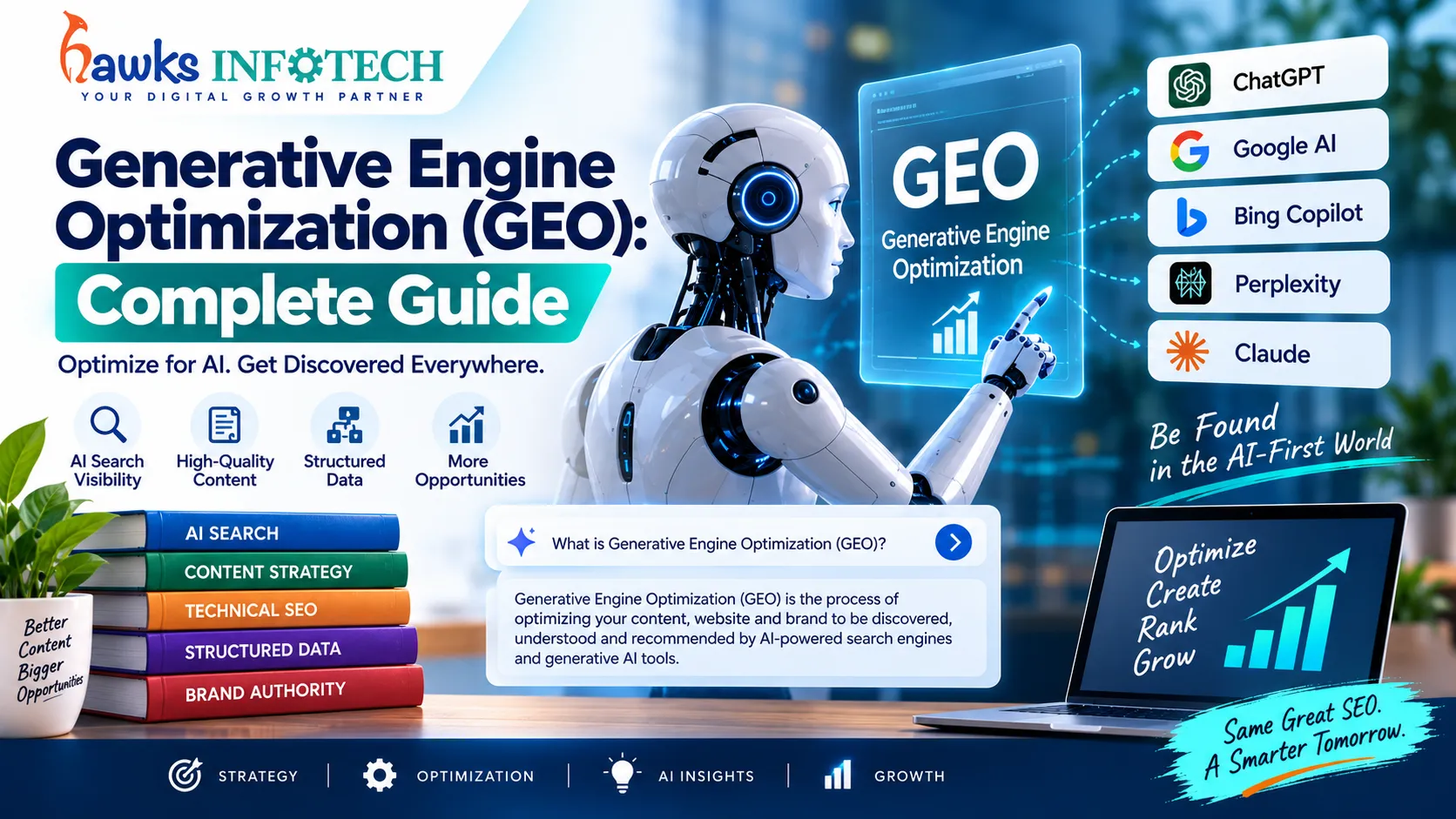
If you have been tracking how AI is changing SEO in 2026 and implemented foundational steps to optimize your website for AI search, your next strategic frontier is Generative Engine Optimization (GEO). Coined by pioneering researchers from Princeton, Georgia Tech, and the Allen Institute for AI, GEO represents the formal scientific discipline of optimizing digital content to maximize visibility, recommendation frequency, and source citations within generative engine outputs.
Scientific Origin
Grounded in empirical benchmarks testing thousands of queries across multimodal LLMs, demonstrating up to 40% relative visibility improvements through deliberate source engineering.
Commercial Objective
Transform your digital brand into an indispensable authority node cited by name whenever customers evaluate solutions in your industry.
Supporting Deep-Dive Guide
Master Pillar: How AI Is Changing SEO in 2026
Table of Contents
Direct Answer: What is Generative Engine Optimization (GEO)?
Generative Engine Optimization (GEO) is the process of tailoring digital content, schema markup, and authoritative brand footprint so that large language models (such as Google Gemini, OpenAI GPT-4o, and Perplexity) select, summarize, and cite your website in AI-generated answers. Unlike traditional SEO focused on keyword positioning, GEO focuses on citation share, factual density, quote attribution, and entity authority.
1. What Exactly Is Generative Engine Optimization (GEO)?
Traditional search engines function as librarians: when you ask a question, they hand you a stack of ten relevant books and leave the reading to you. Generative search engines act as subject-matter analysts: they read all ten books in real-time, synthesize the core findings into a customized briefing, and append footnotes referencing the sources they relied upon most heavily.
Generative Engine Optimization (GEO) is the deliberate practice of ensuring your website provides the most credible, easily extractable "footnotes" for those synthetic briefings. It encompasses content formatting, semantic microdata, entity graph alignment, and third-party web consensus.
Understanding GEO is essential because generative engines now dominate both commercial search queries and research workflows. Whether users search via Google AI Overviews or conversational platforms like ChatGPT Search, brands without a rigorous GEO strategy risk losing their top-of-funnel discovery entirely.
2. GEO vs Traditional SEO: Core Structural Differences
| Strategic Facet | Traditional SEO | Generative Engine Optimization (GEO) |
|---|---|---|
| Evaluation Target | PageRank, keyword density, anchor text | Factual consensus, token relevance, semantic chunk score |
| Output Placement | Ranked organic list of URLs | Inline citation pills, source carousels, answer summaries |
| Click Dynamics | High volume, broad intent clicks | Lower volume, high-intent, decision-ready traffic |
| Competitive Moat | Domain age & backlink counts | Proprietary data, verified expertise, information gain |
3. The 9 Proven GEO Tactics from Empirical Research
In landmark research published on Generative Engine Optimization, scientists evaluated nine distinct optimization strategies across generative search benchmarks. The findings provide a concrete roadmap for modern content teams:
1. Cite Authoritative Sources (+41% Visibility Boost)
Adding direct citations to academic publications, standard bodies, and official documentation significantly increases an LLM's confidence in your text chunk.
2. Include Verifiable Quotations (+38% Visibility Boost)
Integrating direct quotes from industry practitioners and recognized executives elevates the subjective credibility of the document.
3. Integrate Empirical Statistics (+35% Visibility Boost)
Quantifiable benchmark figures and percentages are prioritized during synthesis over vague qualifiers like "very fast" or "cost-effective."
4. Enhance Fluency and Clarity
Simplifying sentence syntax and removing flowery fluff lowers perplexity scores, making your content easier for language models to parse.
5. Use Technical Vocabulary Without Obfuscation
Using domain-precise terminology (e.g. "DNS propagation delay" instead of "domain connection issue") signals high topical depth.
To learn how to execute these techniques across competitive commercial verticals, consult our guide on how to get your business mentioned in AI search results.
4. Optimizing for Multiple AI Engines: Gemini vs GPT vs Perplexity
Different generative platforms exhibit unique retrieval nuances. A successful GEO campaign tailors optimization across the three dominant ecosystem types:
- Google Gemini (AI Overviews): Heavily values existing Google Search Console indexation health, Core Web Vitals, local entity validation via Google Business Profiles, and structured schema.
- OpenAI GPT (ChatGPT Search): Emphasizes high-quality independent journalism, encyclopedic summaries, GitHub discussions, and direct API partnerships.
- Perplexity AI: Acts as an academic research synthesizer, actively prioritizing real-time source freshness, clear Reddit/forum consensus, and transparent bibliographies.
5. Information Gain & The Citation Flywheel
The cornerstone of GEO is Information Gain. In Google's multi-patented ranking algorithm, information gain measures how much new, non-redundant knowledge a document offers compared to what the searcher has already encountered.
If ten web pages all repeat the exact same five bullet points about a topic, the language model generates its synthesis and randomly picks one or two sources. But if your page includes a proprietary benchmark test, an original workflow diagram, or verified pricing analysis, the engine must cite your URL to support that unique claim. That is how the citation flywheel is born.
6. Measuring GEO Success: Modern KPIs for 2026
Because traditional rank tracking software only tracks blue link positions, forward-thinking enterprises use new performance indicators to measure generative engine success:
- Citation Share of Voice (SoV): The percentage of target industry prompts where your brand URL appears in the AI citation carousel.
- LLM Sentiment & Brand Association: How conversational engines describe your services when asked "What are the pros and cons of [Your Brand]?"
- Assisted Conversion Velocity: Tracking the time-to-conversion of visitors originating from AI search engine referral referrers.
7. Frequently Asked Questions
Can you guarantee citations in ChatGPT or Google AI Overviews?
No agency can ethically guarantee algorithmic citations because generative engines synthesize answers dynamically based on real-time prompt context. However, deploying empirical GEO tactics (statistics, authoritative citations, and schema markup) routinely increases citation likelihood by 30% to 40%.
Does GEO replace technical search engine optimization?
No. Technical SEO provides the foundation—clean crawl paths, fast hosting, and error-free indexing. GEO builds upon that foundation by optimizing the informational payload and semantic credibility required for LLM synthesis.
How do I start optimizing my current blog posts for GEO?
Start by rewriting your introductory sections with direct answer cards, inserting empirical benchmark statistics into comparison tables, adding verified author schema, and linking to reputable primary sources.
Topical Cluster: AI Search & Generative Engine Optimization (GEO)
Explore the complete interconnected network of pillar guides and specialized deep-dive articles in this domain:

How AI Is Changing SEO in 2026
Explore the comprehensive master guide that unifies all AI Search & Generative Engine Optimization (GEO) strategies.
How AI Is Changing SEO in 2026

How to Optimize Your Website for AI Search

Google AI Overviews and SEO

ChatGPT Search and the Future of SEO

AI SEO Tools for Businesses

AI vs Human Content: Which Is Better for SEO?
