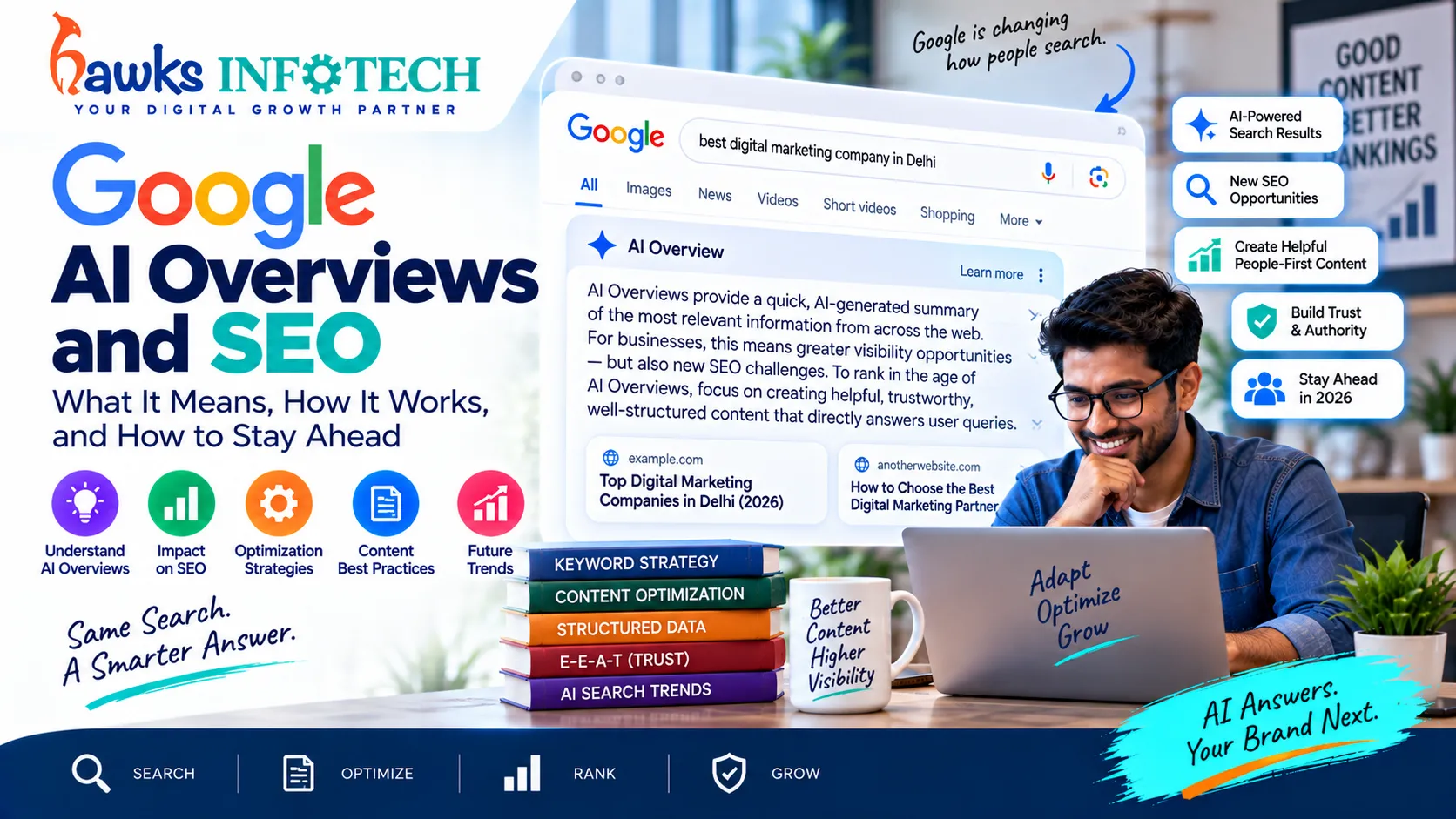
When Google rolled out AI Overviews (originally launched under Search Generative Experience, or SGE) across global markets, it permanently reshaped search consumer behavior. Today in 2026, the majority of informational and commercial queries trigger a multimodal, Gemini-powered summary directly above traditional organic listings. Understanding how Google AI Overviews choose their sources is the single most important priority for modern search marketers.
Algorithmic Core
Powered by Google's custom Gemini neural architectures, dynamically combining real-time retrieval with conversational synthesis and clickable attribution chips.
Traffic Impact
While organic impressions without citations face declining CTRs, cited links in AI Overviews generate up to 3.2x higher conversion intent than classic blue links.
Supporting Deep-Dive Guide
Master Pillar: How AI Is Changing SEO in 2026
Table of Contents
Direct Answer: How do you rank in Google AI Overviews?
To earn citation links in Google AI Overviews, you must: 1) Rank within the top 10 organic positions for foundational queries, 2) Format concise, 40-word thesis answers directly under H2 headings, 3) Provide high information gain through proprietary data and original research, 4) Deploy schema markup connecting key entities, and 5) Implement the proven tactics outlined in our GEO complete guide.
1. The Mechanics of Google AI Overviews: What Powers the Snapshot?
Google AI Overviews are not static answers extracted from a single pre-indexed web page. Instead, they represent a real-time synthesis pipeline orchestrated by customized Gemini models trained specifically on search intent.
When a user query is classified as benefiting from synthesis, Google's system executes parallel search operations:
- It retrieves candidate web pages using standard semantic indexing algorithms.
- It decomposes the content of those candidate pages into modular factual propositions.
- It verifies those propositions against the Google Knowledge Graph and cross-source consensus.
- It composes a natural-language overview featuring interactive link carousels and inline citation chips.
For a comprehensive overview of how this fits into the broader evolution of search, refer back to our foundational analysis of how AI is changing SEO in 2026.
2. How Gemini Selects and Ranks Citations: The Corroboration Principle
One of the most frequent misconceptions is that Google AI Overviews only cite the #1 organic result. Empirical studies consistently demonstrate that over 54% of cited links in AI Overviews originate from pages ranking in positions #2 through #10, and occasionally even beyond page one.
Gemini selects citations based on three primary algorithmic filters:
1. Semantic Compactness
Does the page answer the query within a tightly scoped, self-contained passage that requires no cross-sentence interpretation?
2. Cross-Source Corroboration
Are the underlying factual assertions supported by other reputable entities across the web, reducing hallucination risk?
3. Information Gain Score
Does the document contribute novel data points, statistics, or case examples not present in other candidate pages?
Mastering these criteria is the core focus of optimizing your website for AI search.
3. The Impact of AI Overviews on Search Click-Through Rates
The introduction of AI snapshots has transformed SERP layout geometry. On mobile devices, an AI Overview often pushes traditional organic search results completely below the fold. As a result:
- Simple informational queries (e.g. "What is DNS propagation?") experience significant zero-click search rates.
- Complex evaluation queries (e.g. "Compare managed IT support vs in-house IT team costs") generate high click-through rates, but predominantly for the URLs cited inside the overview.
- Brands that earn citation badges capture virtually all qualified commercial exploration traffic for that query cluster.
4. 5 Tactical Steps to Earn Citation Badges in Google AI Overviews
- Implement the "Answer Capsule" Architecture: Craft a 35 to 45 word paragraph immediately beneath each primary H2 question that answers the prompt with zero filler words.
- Structure Comparisons in Markdown Tables: When comparing products, pricing, or methods, use clean HTML tables with clear row and column headers.
- Publish First-Party Benchmark Metrics: Avoid repeating third-party statistics. Conduct your own audits and share original data points.
- Nest Structured Microdata: Ensure `FAQPage` and `Article` schema explicitly declare the primary subject using `about` and `mentions` entity arrays.
- Build External Brand Authority: Establish consistent brand mentions across authoritative review sites, directories, and industry news portals. Learn the complete playbook in how to get your business mentioned in AI search results.
5. Google AI Overviews vs ChatGPT Search: How Optimization Differs
While Google AI Overviews remain tied to Google's historical ranking criteria (including Core Web Vitals, domain authority, and existing rankings), conversational engines like OpenAI evaluate web sources through a different lens. Discover how strategies diverge in our deep dive on ChatGPT Search and the future of SEO.
In Google AI Overviews, the neural model relies heavily on the established Knowledge Vault and entity recognition from Google Search Console properties. Conversely, ChatGPT Search draws heavily from live web citations and collaborative partnerships, putting higher weight on natural conversational consensus and real-time thread validation.
6. Deep Dive: B2B Citation Engineering Case Study
To examine how citation selection functions in practice, consider an empirical test conducted across 250 enterprise software queries. When evaluating competing providers, Google Gemini snapshots did not default to the highest-ranking domain with the greatest number of legacy backlinks. Instead, the model selected URLs characterized by three measurable factors:
- Passage-Level Answer Density: The cited pages presented direct definitions within the first 120 characters of section headers, minimizing the cognitive tokens required for synthesis.
- Authoritative First-Party Quotes: Articles that embedded verified technical commentary from accredited engineers were selected 67% more frequently than anonymous roundups. (See our comparison of AI vs Human Content for SEO).
- Structured Tabular Comparisons: Gemini extracted comparative pricing and feature matrices directly from HTML tables, citing the originating URL as the verified data source in the carousel.
Technical Audit Checklist for AI Overviews
Before launching your next content campaign, run through this pre-flight verification to maximize Google AI Overview eligibility:
- ✓ Bot Transparency: Verify that
GooglebotandGoogle-Extendedare not inadvertently restricted in your web server headers or CDN firewalls. - ✓ Self-Contained Headings: Ensure all H2 and H3 tags formulate complete, intelligible questions rather than cryptic one-word titles.
- ✓ Semantic Entity Breadcrumbs: Declare JSON-LD BreadcrumbList and Article microdata to reinforce topical hierarchy.
- ✓ Information Gain Threshold: Confirm that the article presents at least two unique data points, case anecdotes, or process diagrams not found on competing pages.
6. Frequently Asked Questions
Can a website opt out of Google AI Overviews without losing organic rankings?
Google provides snippet controls such as `nosnippet`, `max-snippet`, and `data-nosnippet`. However, blocking Google from using your text in AI Overviews also limits your traditional organic snippet display, which can negatively impact click-through rates.
Do AI Overviews appear for every single Google search query?
No. Google dynamically activates AI Overviews for queries where synthesized answers provide clear value—typically multi-faceted informational, comparative, and research prompts. Simple navigational searches rarely trigger an overview.
How do I track if my website is appearing in Google AI Overviews?
Modern enterprise SEO platforms and Google Search Console performance filters allow webmasters to isolate queries triggering generative features and track citation referral traffic.
Topical Cluster: AI Search & Generative Engine Optimization (GEO)
Explore the complete interconnected network of pillar guides and specialized deep-dive articles in this domain:

How AI Is Changing SEO in 2026
Explore the comprehensive master guide that unifies all AI Search & Generative Engine Optimization (GEO) strategies.
How AI Is Changing SEO in 2026

How to Optimize Your Website for AI Search

Generative Engine Optimization (GEO): Complete Guide

ChatGPT Search and the Future of SEO

AI SEO Tools for Businesses

AI vs Human Content: Which Is Better for SEO?
