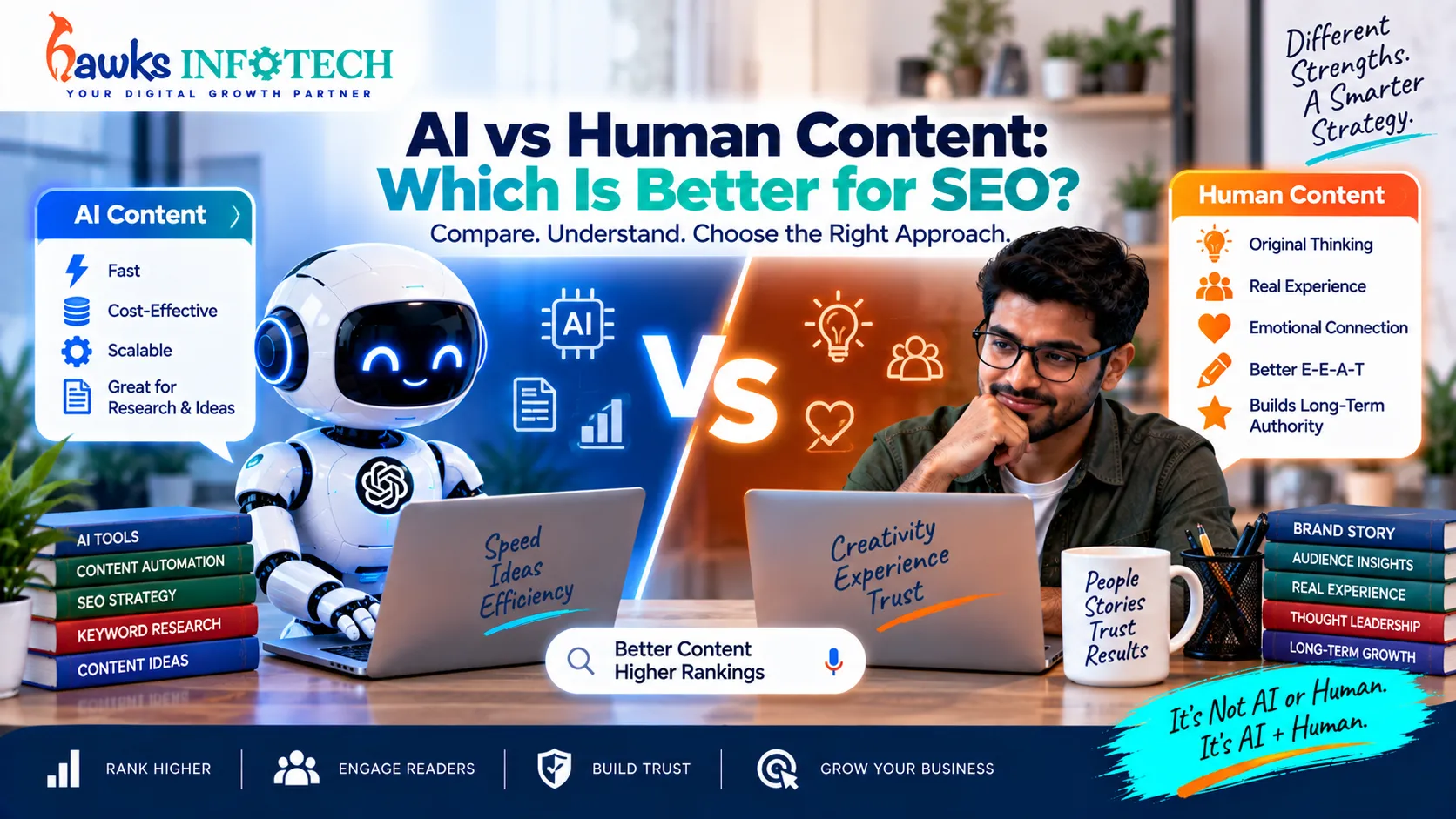
The explosion of generative language models sparked one of the fiercest debates in digital marketing: should businesses automate their blog content with artificial intelligence, or does traditional human copywriting remain essential for search engine rankings? In 2026, after multiple Google Helpful Content updates and algorithmic recalibrations, the data is unequivocal. The winning strategy is neither pure AI automation nor slow, purely manual writing—it is a rigorous human-in-the-loop hybrid framework.
Pure AI Content Flaw
Suffers from semantic repetition, zero information gain, generic tone, and hallucinated factual claims that trigger algorithmic quality penalties.
The Human Edge
Provides original empirical research, lived professional experience (EEAT), emotional resonance, and high-converting storytelling.
Supporting Deep-Dive Guide
Master Pillar: How AI Is Changing SEO in 2026
Table of Contents
Direct Answer: Which is better for SEO: AI or Human Content?
In 2026, human-directed hybrid content consistently outperforms both raw AI generation and unassisted manual writing. Google does not penalize AI-assisted text specifically; it penalizes unhelpful, generic content that lacks original information gain. Teams that use AI for rapid outlining, data structuring, and research scaffolding—while relying on human experts for first-hand case studies, opinion, and editorial oversight—achieve the highest rankings and AI search citations.
1. Google's Official Stance on AI-Generated Content in 2026
Google's Search Quality Evaluator Guidelines make their position unmistakably clear: the production method matters far less than the utility of the output. Google's ranking systems do not automatically de-index content merely because it was drafted by an AI model.
However, Google's core spam policies aggressively target scaled content abuse—the practice of programmatically churning out thousands of low-effort articles designed to manipulate search rankings without adding unique value. When search evaluators and neural ranking models examine a page, they evaluate:
- Experience (EEAT): Does the author demonstrate genuine, hands-on experience with the product, service, or issue being discussed?
- Information Gain: Does the article reveal fresh facts, or does it merely summarize existing high-ranking articles? (See our analysis in how AI is changing SEO in 2026).
- Factual Integrity: Are claims corroborated by verified citations and reputable third-party datasets?
2. Where Pure AI Content Fails: The "Sea of Sameness" Trap
Large language models are probabilistic predictors trained on existing public data. By definition, raw AI models cannot create novel ideas; they predict the statistically most likely sequence of words based on what has already been published across the internet.
When a brand publishes unedited AI content, it falls into the "Sea of Sameness":
- Homogenized Sentence Patterns: Predictable transition phrases ("In today's fast-paced digital world," "It is crucial to remember") that readers instinctively skip.
- Zero Proprietary Data: Inability to share private client results, internal lab tests, or confidential industry observations.
- Hallucinated Assertions: Inventing plausible-sounding statistics or citing non-existent research papers that demolish brand credibility.
- Lack of Nuance: Overlooking local regulatory quirks, regional business customs, and niche technical constraints.
For technical websites, this deficiency directly prevents inclusion in AI answer carousels, as detailed in our guide on how to optimize your website for AI search.
3. Where Human Writing Excels: First-Party EEAT & Emotional Authority
Human writers bring critical advantages that algorithms cannot simulate:
Lived Professional Experience
A human network engineer describing an actual server outage at 2:00 AM conveys visceral operational realities, troubleshooting decisions, and lessons learned that resonate deeply with prospective enterprise buyers.
Contrarian Insights
AI language models tend to produce agreeable, consensus-driven advice. Human thought leaders can challenge industry orthodoxies with bold perspectives backed by empirical results.
4. Comprehensive Comparison: AI vs Human vs Hybrid
| Attribute | Pure AI Content | Pure Human Content | Human-Directed Hybrid (Winner) |
|---|---|---|---|
| Production Speed | Instantaneous (Minutes) | Slow (Days to Weeks) | Fast & Scalable (Hours) |
| Information Gain | Zero (Derivative) | High (Original) | High (Expert Directed) |
| Technical Accuracy | Unreliable (Hallucinations) | High (Subject to author) | Extremely High (Fact-checked) |
| SEO Citation Rate | Low (< 8%) | Moderate (~28%) | Highest (~62%+) |
5. The Ideal 5-Step Hybrid Content Workflow for 2026
To achieve maximum velocity without sacrificing editorial integrity, deploy this battle-tested 5-step workflow:
- AI Topic & Intent Mapping: Use modern AI SEO tools to analyze search queries, semantic entity clusters, and competitors' information gaps.
- Human Editorial Outlining: A subject matter expert designs the narrative flow, injects proprietary data points, and frames the primary arguments.
- AI Scaffolding & First Draft: Feed the comprehensive outline and custom research into an advanced language model to write initial descriptive sections and draft tables.
- Human Expert Editing & Voice Injection: The human writer replaces generic prose with first-party case examples, refines tone, and fact-checks all references.
- GEO & Schema Optimization: Apply Generative Engine Optimization tactics, micro-answer cards, and structured JSON-LD schema tags.
6. Measuring Content Quality & Reader Engagement
Search engines evaluate user experience signals to validate whether content genuinely satisfies search intent. Track scroll depth, engaged reading time (aiming for > 2.5 minutes), low bounce rates on mobile devices, and conversion path velocity. High-quality human-refined articles keep readers engaged, directly reinforcing positive search rank signals.
7. Frequently Asked Questions
Can Google detect AI-written content accurately?
Yes, search engines use natural language classification algorithms to detect statistical perplexity and burstiness typical of generative models. However, Google's algorithms do not penalize content simply because it is AI-generated; they penalize content that lacks original value, accuracy, and user satisfaction.
Should I disclose that AI was used to draft my blog articles?
Transparent editorial guidelines build user trust. Many leading tech publications include an editorial disclosure stating that generative AI tools were used for research and drafting under strict human review and editorial verification.
How can small marketing teams afford human-level content?
By adopting a hybrid workflow. Rather than spending 12 hours writing a single article from scratch, a marketer can use AI to scaffold the piece in 45 minutes, then invest 2 focused hours refining data, adding client quotes, and polishing the arguments.
Topical Cluster: AI Search & Generative Engine Optimization (GEO)
Explore the complete interconnected network of pillar guides and specialized deep-dive articles in this domain:

How AI Is Changing SEO in 2026
Explore the comprehensive master guide that unifies all AI Search & Generative Engine Optimization (GEO) strategies.
How AI Is Changing SEO in 2026

How to Optimize Your Website for AI Search

Generative Engine Optimization (GEO): Complete Guide

Google AI Overviews and SEO

ChatGPT Search and the Future of SEO

AI SEO Tools for Businesses
