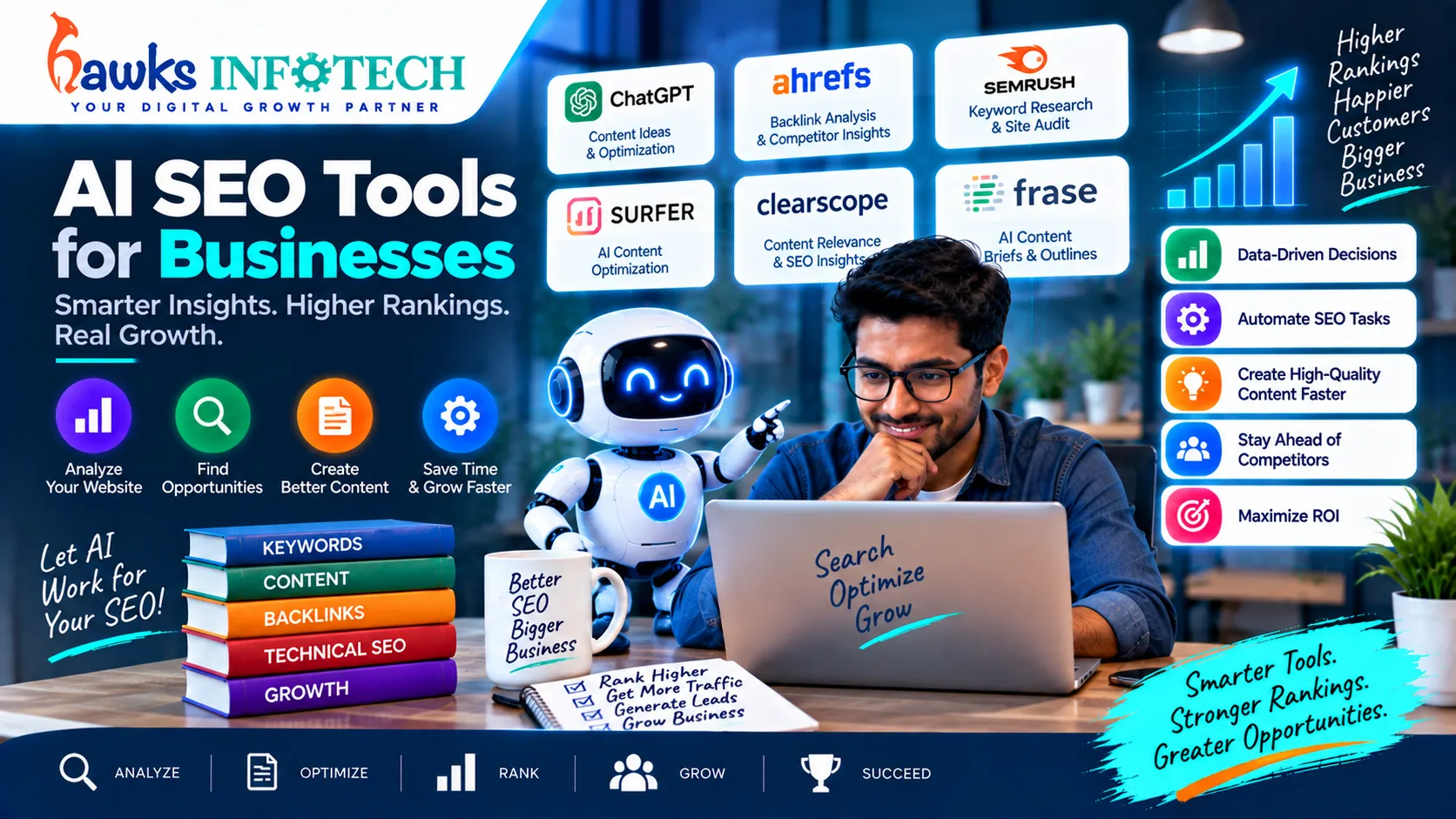
Managing search engine optimization manually in 2026 is no longer feasible. As search algorithms shift toward real-time semantic comprehension and conversational generative answers, enterprise marketing teams rely on a new generation of AI SEO tools to analyze billions of search tokens, detect entity gaps, automate structured data implementation, and track brand citations across AI platforms.
Semantic Intelligence
Next-gen platforms move beyond raw search volume to model topical coverage, knowledge graph entity clusters, and conversational prompt variations.
Generative Tracking
Track your brand's Share of Voice in Google AI Overviews, Perplexity, and ChatGPT Search alongside traditional keyword positions.
Supporting Deep-Dive Guide
Master Pillar: How AI Is Changing SEO in 2026
Table of Contents
Direct Answer: What are the best AI SEO tools for businesses?
The leading AI SEO tools in 2026 include: Semrush AI Copilot (for holistic visibility and competitive gap detection), Surfer AI (for real-time semantic entity content optimization), BrightEdge Generative Parser (for enterprise AI Overview monitoring), MarketMuse (for topical authority modeling), and Clearscope (for NLP clarity and read-time optimization).
1. The Evolution of SEO Software: From Keyword Trackers to Reasoning Engines
Legacy SEO software operated like database spreadsheets: you uploaded a list of 500 keywords, and the tool scraped rankings daily. But as established in our foundational guide on how AI is changing SEO in 2026, search engines no longer rank isolated strings.
Modern AI SEO tools utilize vector embeddings and semantic graph analysis. Rather than asking "How many times did we mention keyword X?", modern software evaluates:
- Topical Completeness Score: Does your content cover the underlying sub-entities expected by neural ranking algorithms?
- Information Gain Predictor: Does your draft introduce novel assertions, or is it statistically identical to competitor URLs?
- Conversational Prompt Coverage: Which conversational phrasing variations are users asking inside ChatGPT Search and Gemini?
2. Top 5 AI SEO Platforms Reviewed
1. Semrush AI Intelligence Suite
Best All-in-One Enterprise ToolSemrush integrates generative intelligence across keyword research, backlink toxic audits, and competitive intelligence. Its AI Copilot scans daily performance fluctuations and delivers prioritized action checklists.
2. Surfer SEO & Surfer AI
Best for On-Page Semantic OptimizationSurfer analyzes top-ranking documents in real time, extracting essential NLP entities, heading architectures, and question clusters. Its automated drafting module creates clean outlines primed for hybrid editorial workflows.
3. MarketMuse
Best for Topical Authority ArchitectureMarketMuse conducts patented topic modeling to identify structural content gaps across your entire domain. It helps businesses construct authoritative topic clusters that demonstrate deep domain authority to search models.
3. Comprehensive Feature & Pricing Comparison
| Platform | Best Use Case | AI Features | Starting Price |
|---|---|---|---|
| Semrush | Full-funnel SEO & PPC | AI Copilot, intent clustering, automated reporting | $139 / mo |
| Surfer SEO | On-page entity optimization | NLP entity scoring, automated drafting, SERP analyzer | $89 / mo |
| MarketMuse | Topical authority planning | Content gap analysis, personalized difficulty, entity graphs | $149 / mo |
| Clearscope | Enterprise content grading | Google Natural Language API integration, readability tuning | $189 / mo |
4. Specialized Tools for GEO & AI Citation Tracking
Traditional position tracking tools measure only positions 1 through 100 on standard search pages. However, modern growth teams require specialized platforms to track their presence within AI answer snapshots:
- Generative Visibility Monitors: Programmatically prompt Gemini and ChatGPT with high-intent queries to measure brand inclusion rates over time. Learn more in how to get your business mentioned in AI search results.
- Entity Disambiguation Scanners: Query Wikidata and Google Knowledge Graph APIs to verify your brand's schema connectivity. Follow our technical blueprint in how to optimize your website for AI search.
- Information Gain Analyzers: Compare draft articles against top-ranking URLs to score originality before publication.
5. How to Build an Integrated AI SEO Tech Stack
Rather than purchasing dozens of fragmented subscriptions, enterprise businesses build streamlined stacks featuring three complementary layers:
- Research & Competitive Intelligence Layer: An all-in-one suite (Semrush or Ahrefs) to audit backlink health, monitor organic traffic, and identify competitive keyword clusters.
- Content Modeling & Entity Layer: A semantic optimizer (Surfer or MarketMuse) to guide writers with real-time entity targets and optimal heading structures.
- Execution & Technical Foundation: Partnering with a specialized technical SEO and Generative Engine Optimization agency to execute complex schema architectures and server-side performance tuning.
6. Avoiding Costly Software Shelfware & Maximizing Tool ROI
Enterprise marketing teams frequently fall into the trap of purchasing expensive software suites without the internal technical bandwidth to execute the recommendations. To maximize ROI on your AI SEO tooling investment:
- Assign Dedicated Workflow Owners: Designate a technical SEO specialist to review automated audit alerts weekly and an editorial lead to oversee semantic content grading.
- Integrate Real-Time Alerts with Communication Hubs: Pipe critical crawl failure alerts, sudden Core Web Vitals regressions, and broken schema warnings directly into Slack or Microsoft Teams.
- Benchmark Conversion Velocity Against Organic Lift: Verify that ranking improvements translate directly into qualified sales leads, trial signups, or consultative bookings.
The Modern AI SEO Stack Architecture
A balanced digital marketing tool stack in 2026 combines automated intelligence with human-led technical agility across four functional zones:
6. Frequently Asked Questions
Can AI SEO tools replace an experienced SEO agency?
No. AI SEO tools are diagnostic instruments, not strategic decision-makers. They identify entity gaps and score readability, but they cannot formulate high-level brand positioning, conduct proprietary field research, or negotiate high-value media partnerships.
Are there free AI SEO tools suitable for small businesses?
Yes. Tools like Google Search Console, Google Trends, free schema validators, and base ChatGPT/Gemini conversational prompts offer substantial diagnostic value without ongoing monthly licensing fees.
How do AI SEO tools help with Generative Engine Optimization (GEO)?
They analyze which questions generative engines frequently synthesize, calculate the factual density of competing web pages, and reveal missing sub-topics needed to qualify for citation badges.
Topical Cluster: AI Search & Generative Engine Optimization (GEO)
Explore the complete interconnected network of pillar guides and specialized deep-dive articles in this domain:

How AI Is Changing SEO in 2026
Explore the comprehensive master guide that unifies all AI Search & Generative Engine Optimization (GEO) strategies.
How AI Is Changing SEO in 2026

How to Optimize Your Website for AI Search

Generative Engine Optimization (GEO): Complete Guide

Google AI Overviews and SEO

ChatGPT Search and the Future of SEO

AI vs Human Content: Which Is Better for SEO?
