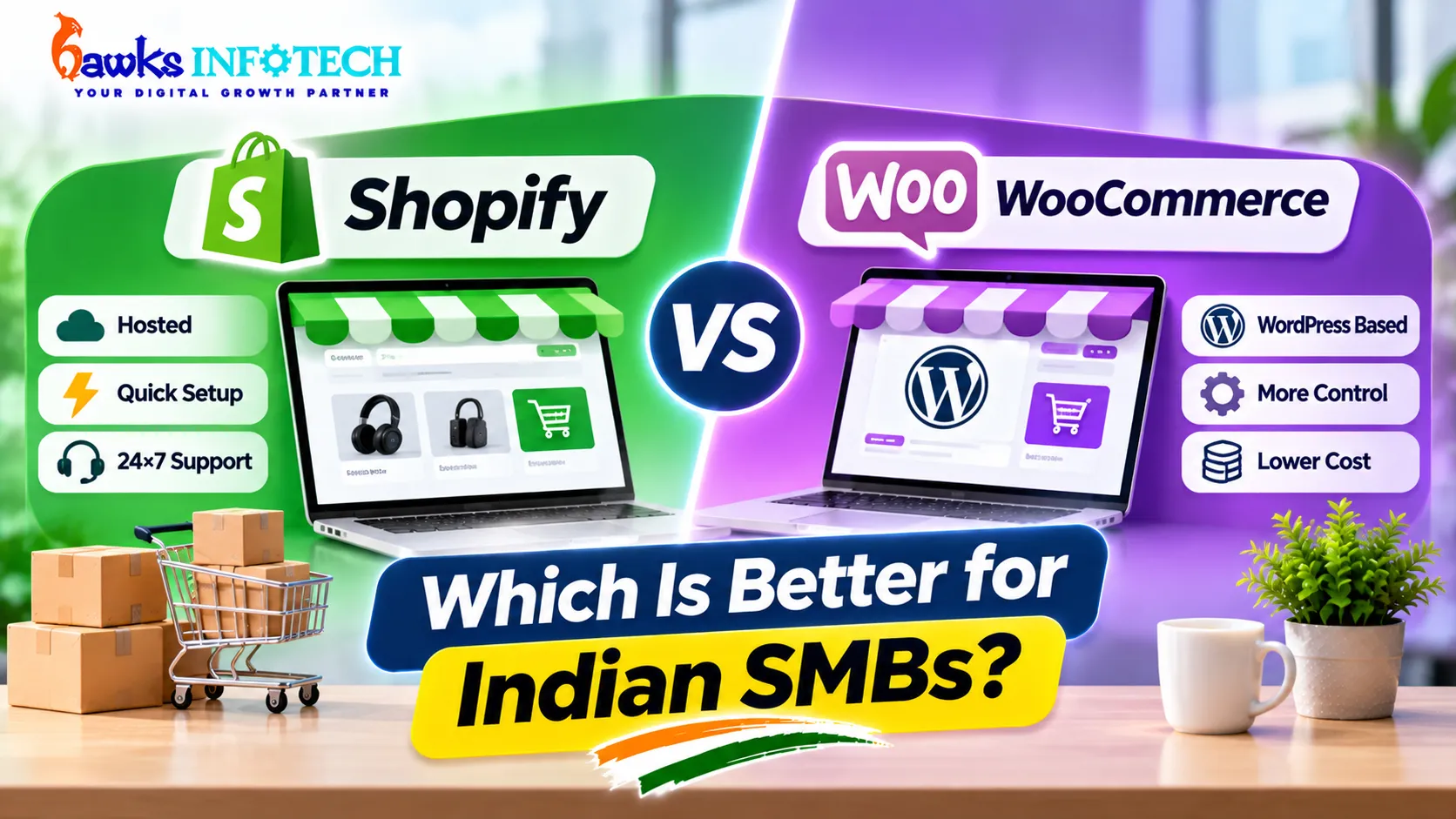
For Indian small businesses, choosing between Shopify and WooCommerce comes down to weighing predictable monthly software fees against complete data ownership and long-term cost efficiency. Shopify delivers a hassle-free, fully hosted environment starting around ₹1,999/month plus transaction fees, making it an excellent match for entrepreneurs seeking rapid launches without technical maintenance. Conversely, WooCommerce operates as an open-source WordPress plugin offering complete customization freedom, zero platform transaction percentages, and seamless integration with affordable Indian payment gateways like Razorpay and Cashfree, with custom store development by Hawks Infotech typically ranging from ₹18,000 to ₹45,000.
The App Subscription Trap
While Shopify's base plan begins around ₹1,999/month, adding essential e-commerce apps for Cash on Delivery (COD) verification, product reviews, GST invoicing, and WhatsApp order alerts can quickly push monthly software bills past ₹8,000 to ₹12,000.
Delhi E-Commerce Engineering
Hawks Infotech builds high-performance online stores across Delhi NCR, integrating Indian payment gateways, automated Shiprocket/iThink logistics, and speed-optimized product catalogs tailored for mobile Indian consumers.
Table of Contents
1. Platform Overviews: Hosted SaaS vs Open-Source WordPress
Understanding the fundamental engineering differences between these two dominant e-commerce systems is essential before writing a single line of code or picking a theme:
Shopify (Hosted Software-as-a-Service): Shopify is an all-in-one subscription platform where hosting, server security, SSL certificates, payment gateway checkouts, and software upgrades are managed centrally by Shopify engineers. You never manage cPanel, PHP versions, or MySQL databases. The trade-off is that you operate within Shopify's proprietary closed garden: you cannot modify the core checkout codebase (unless on the enterprise Shopify Plus tier costing $2,000+/month), you pay extra transaction fees when using external payment processors, and you must pay recurring monthly subscription fees indefinitely.
WooCommerce (Self-Hosted Open-Source WordPress): WooCommerce powers roughly 25% of the top 1 million e-commerce stores globally. It is an open-source software suite that runs on your own web hosting server. You own 100% of your source code, customer databases, product files, and order histories. There are zero platform transaction cuts on sales, and you have complete freedom to customize layouts, checkout flows, and database schemas. However, your team (or your agency partner) is responsible for managing hosting performance, plugin updates, and caching. For a detailed breakdown of core development pricing, see our guide on website development costs in Delhi.
2. True Cost of Ownership: Year 1 vs Year 3 in Indian Rupees
Most new store owners compare Shopify's Basic ₹1,999/month plan against standard web hosting and assume the costs are comparable. In reality, recurring app subscriptions create a massive financial gap over a 3-year operating period:
| Cost Component | Shopify Store (Estimated 3-Yr Cost) | WooCommerce Store (Estimated 3-Yr Cost) |
|---|---|---|
| Base Software / Platform Fee | ₹1,999/mo × 36 = ₹71,964 | ₹0 (Open Source WordPress Plugin) |
| Hosting & Server Infrastructure | Included in base fee | High-speed NVMe Cloud VPS: ~₹450/mo × 36 = ₹16,200 |
| Essential E-Commerce Apps (COD OTP, GST Invoicing, Reviews, WhatsApp) | ~$40/mo (₹3,300/mo) × 36 = ₹1,18,800 | One-time / free open-source plugins = ₹6,000 – ₹12,000 total |
| Platform Transaction Surcharge | 2.0% extra cut on every external gateway sale (plus 2% gateway charge) | 0% platform fee; pay only standard ~2% payment gateway fee |
| Turnkey Development by Hawks Infotech | ₹18,000 – ₹32,000 (one-time setup) | ₹22,000 – ₹45,000 (one-time custom build) |
| Estimated Total 3-Year Investment | ~₹2,10,000 – ₹2,50,000 + 2% sales cut | ~₹45,000 – ₹75,000 (Complete Ownership) |
3. Indian Payment Gateways & Cash on Delivery (COD) OTPs
Operating an e-commerce store in India has unique requirements that Western platforms often handle awkwardly:
- Cash on Delivery (COD) Verification: In India, between 50% and 75% of initial orders are placed via COD. Unverified COD orders suffer Return to Origin (RTO) courier rates as high as 35%, draining your profit margins. On WooCommerce, Hawks Infotech integrates custom SMS/WhatsApp OTP verification plugins that validate customer phone numbers before checkout. On Shopify, this requires third-party paid apps or custom checkout scripts.
- Payment Gateway Integration: Both platforms support major Indian payment aggregators—including Razorpay, Cashfree, PhonePe Payment Gateway, and Paytm. However, because Shopify does not offer native "Shopify Payments" powered by Indian UPI, Shopify levies an additional 2.0% third-party transaction fee on top of Razorpay's standard 2% rate unless you negotiate specialized enterprise terms.
- B2B GST Invoicing: Indian businesses must provide B2B buyers with compliant GST tax invoices showing GSTIN numbers, state codes, and HSN breakdowns. WooCommerce handles this natively through modular free extensions, whereas Shopify requires monthly subscription apps.
4. SEO Architecture & Organic Search Capabilities
Search Engine Optimization directly determines your customer acquisition cost. In this arena, WooCommerce has distinct architectural advantages:
- URL Structure Freedom: Shopify forces hard-coded URL subdirectories (e.g.,
/products/item-nameand/collections/category-name) that you cannot remove. WooCommerce allows completely flexible, keyword-rich URL permalinks. - Advanced Schema Markup: On WooCommerce, developers can programmatically inject granular Product, AggregateRating, Offer, and BreadcrumbList JSON-LD schemas matching current search guidelines. Learn more about effective schema in our SEO company selection guide for Delhi.
- Integrated Content Marketing: Because WooCommerce is built on WordPress—the world's most capable blogging engine—publishing long-form buying guides, customer stories, and comparison articles is seamless and highly optimized for search crawlers.
5. Decision Framework: Which One Should Your Business Pick?
Use this clear decision framework based on your team's internal resources and commercial objectives:
Choose Shopify If:
- You have zero technical coding skills and no developer on retainer.
- You want to launch a 10-product boutique catalog within 3 to 5 days.
- You prefer predictable software subscriptions over managing hosting servers.
- Your product margins are healthy enough to absorb recurring monthly app bills and transaction percentages.
Choose WooCommerce If:
- You want complete ownership of your customer database and website code.
- You want to minimize long-term operating overheads and eliminate monthly SaaS fees.
- You have a catalog of 100+ SKUs with custom product variations, wholesale pricing tiers, or complex GST calculations.
- You want an experienced Delhi development agency like Hawks Infotech to engineer a custom, lightning-fast store tailored to your brand.
6. Frequently Asked Questions (FAQs)
Can Hawks Infotech migrate our existing Shopify store to WooCommerce?
Yes. We frequently migrate established D2C brands tired of high Shopify app subscriptions over to WooCommerce. We export all product catalogs, historical customer accounts, order records, and configure 301 URL redirects so you retain 100% of your existing Google SEO rankings without broken links.
Can WooCommerce handle high traffic during festive Indian sales like Diwali?
Yes, absolutely. When paired with high-performance Redis object caching, Cloudflare CDN integration, and optimized NVMe VPS servers, WooCommerce comfortably handles thousands of concurrent shoppers during festive flash sales without slowdowns.
How do Indian shipping aggregators like Shiprocket integrate with both platforms?
Both Shopify and WooCommerce offer direct API integrations with Shiprocket, Delhivery, iThink Logistics, and Pickrr. When an order is placed, tracking numbers and shipping labels are automatically generated and synchronized back to customer SMS and email notifications.
How much does custom e-commerce website development cost at Hawks Infotech?
Turnkey e-commerce development typically ranges from ₹18,000 to ₹32,000 for standard boutique catalog stores, and ₹35,000 to ₹65,000 for advanced multi-vendor, custom B2B, or high-volume stores featuring automated logistics and custom payment gateways.
Is it difficult for our non-technical staff to add new products on WooCommerce?
Not at all. We provide comprehensive hands-on training and simplified admin dashboards. Adding a new product, updating prices, or reviewing inventory takes under two minutes through an intuitive WordPress interface.