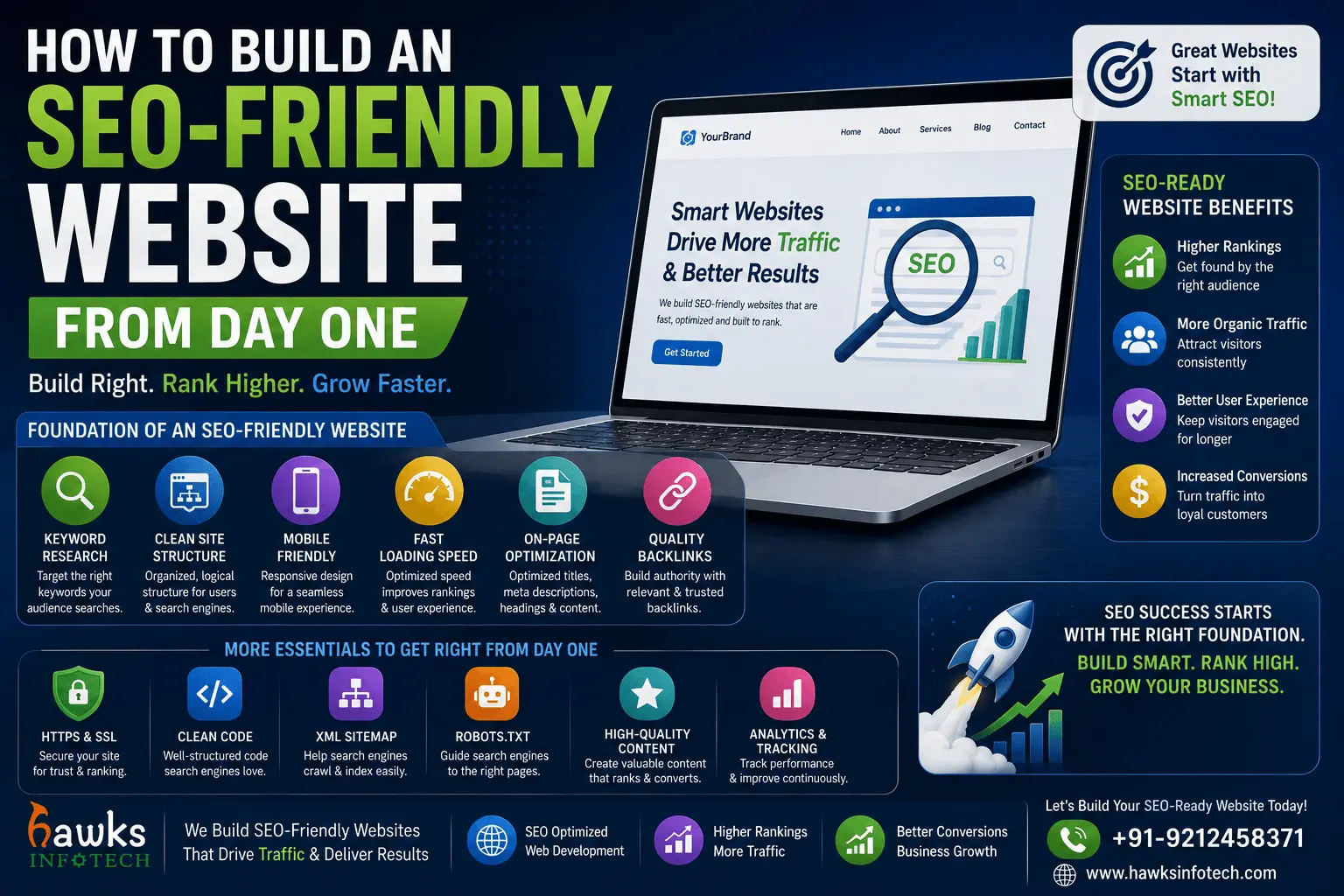
The most expensive mistake in digital marketing is building a beautiful website first and attempting to 'add SEO later'. When a website launches with flawed URL structures, render-blocking JavaScript, missing canonical tags, and un-crawlable navigation, redesigning the technical foundation after launch costs thousands of dollars and causes severe organic traffic delays.
Target Audience
This actionable technical blueprint is written for web developers, UI/UX designers, project managers, and business owners building a new website from scratch.
What You Will Learn
You will learn the step-by-step developer SEO framework: engineering logical URL hierarchies, establishing topical internal linking silos, implementing multi-tier JSON-LD schema, optimizing Core Web Vitals, and executing zero-downtime launch redirects.
Supporting Deep-Dive Guide
Pillar Parent: Website Development Trends in 2026: Modern Web Standards
Quick Answer & Key Strategic Takeaway
To build an SEO-friendly website from day one, design a flat 3-click site architecture, use semantic HTML5 elements (<header>, <main>, <h1>-<h6>), configure clean canonical URLs, embed rich Schema.org JSON-LD markup on server-rendered templates, ensure sub-1 second mobile loading speeds, and generate dynamic XML sitemaps.
Table of Contents
1. What Is Technical SEO-First Web Development?
Technical SEO-first web development is the practice of integrating search engine crawlability, indexability, speed, and semantic hierarchy directly into the foundational code, database schema, and design wireframes of a website before a single line of frontend code is launched.
Rather than relying on clunky third-party plugins that bloat code after launch, an SEO-first website natively outputs clean structured markup, automated XML sitemaps, self-referencing canonical tags, and optimized asset delivery pipelines out of the box.
When search engine bots like Googlebot and GPTBot crawl an SEO-architected site, they can discover, render, and index every page with maximum crawl budget efficiency.
2. Why Baking SEO into Web Design Saves Months of Frustration
Websites launched with strong technical SEO foundations begin ranking for targeted commercial keywords within 3 to 6 weeks of launch. In contrast, poorly architected sites often languish in Google's indexing sandbox for 6 to 9 months while technicians repair structural code errors.
Fixing architectural flaws—such as un-crawlable client-side JavaScript rendering, duplicate content URL parameters, or flawed mobile viewport configurations—often requires rebuilding the entire frontend from scratch.
An SEO-friendly website provides a friction-free launchpad that amplifies the return on all future content marketing and digital PR investments.
3. The 7-Step Developer SEO Blueprint for New Websites
To execute this strategy with maximum efficiency, implement the following prioritized step-by-step framework:
Design a Flat, Logical 3-Click Site Architecture
Structure content silos so that every important service and category page is accessible within 3 clicks from the homepage: Home > Category > Service > Sub-service. Avoid deep, nested URL sprawl.
Enforce Clean, Descriptive, Lowercase URL Slugs
Use clean hyphenated URLs (e.g., /digital-marketing/seo-services) without uppercase letters, file extensions (.php/.html), or dynamic query parameters (?id=123).
Enforce Strict Heading Hierarchy (One H1 per Page)
Ensure every page contains exactly one <h1> defining the primary topic, followed by logically ordered <h2>, <h3>, and <h4> subheadings. Never use heading tags purely for visual styling.
Implement Automated Self-Referencing Canonical Tags
Dynamically inject canonical link tags in the <head> of every template to prevent duplicate content penalties from HTTP/HTTPS, trailing slashes, or tracking parameters.
Embed Native Schema.org JSON-LD Structured Data
Hardcode dynamic JSON-LD schema generators into template headers: Organization on homepage, LocalBusiness on contact pages, Service on service pages, and BreadcrumbList across all pages.
Configure Automated XML Sitemaps and Robots.txt Directives
Build automated scripts that regenerate sitemap.xml whenever new pages or articles are published. Configure robots.txt to permit search crawlers while disallowing private admin directories.
Execute 1-to-1 301 Redirect Mapping for Legacy URLs
If redesigning an existing site, create an exhaustive spreadsheet mapping every old URL to its new equivalent with server-level 301 Permanent Redirects to preserve 100% of accumulated backlink authority.
4. The Pitfalls of Client-Side Single Page Applications (SPAs) for SEO
Deep-dive technical execution requires understanding real-world operational variables. Below is an authentic implementation scenario illustrating the measurable impact of this methodology:
Practical Example: The JavaScript Rendering Dilemma
A fintech startup launched a web portal built entirely with client-side React (SPA) without Server-Side Rendering (SSR). When Googlebot crawled the site, it saw blank root div containers because JavaScript execution was deferred, resulting in zero indexed pages for 4 months. By migrating to a Server-Side Rendered (Next.js / custom SSR PHP) architecture, Google indexed all 150 product pages within 14 days, driving an immediate 380% surge in organic impressions.
5. Engineering Internal Linking Silos for Topical Authority
Scalable execution requires addressing workflow edge-cases and optimization trade-offs:
Practical Example: Contextual Service to Local Page Mapping
Structure contextual internal link modules: Top-tier service pages link to specialized sub-services, sub-services link to local geographic landing pages, and educational blog posts link back to commercial service conversion pages. This bidirectional linking distributes PageRank equity throughout your entire domain.
6. Common Mistakes to Avoid in 2026
Organizations frequently undermine their performance by committing critical tactical errors. Guard against these costly pitfalls:
Mistake 1: Launching with 'Lorem Ipsum' placeholder text in meta descriptions and title tags.
Mistake 2: Leaving noindex, nofollow staging robots meta tags active on the live production server.
Mistake 3: Hiding critical content behind un-crawlable JavaScript click tabs or accordions without semantic HTML fallbacks.
Mistake 4: Failing to set up custom 404 error pages with helpful search and navigation links.
Mistake 5: Ignoring mobile viewport configuration (<meta name="viewport" content="width=device-width, initial-scale=1.0">).
7. Action Plan & Technical Checklist
Use this structured comparison and audit matrix to benchmark your operational readiness:
| SEO Audit Category | Technical Requirement | Verification Method |
|---|---|---|
| Crawlability | Robots.txt allows search crawlers & AI bots | Test via Google Search Console Robots Tester |
| Indexability | Canonical tag matches exact URL + no stray noindex tags | Inspect page source & URL Inspection Tool |
| Heading Structure | Exactly 1 H1 per page + logical H2/H3 hierarchy | Browser Web Developer Extension heading audit |
| Schema Validation | Valid JSON-LD without syntax errors | Google Rich Results Test / Schema.org Validator |
| Mobile Performance | Sub-1.5s LCP & zero layout shift (CLS < 0.05) | Google PageSpeed Insights & Chrome DevTools |
| Redirect Integrity | All legacy URLs 301 redirected with zero 404 chains | Screaming Frog SEO Spider crawl audit |
8. Frequently Asked Questions
What is the biggest SEO mistake made during website redesigns?
The single biggest mistake is changing URL structures without setting up server-side 301 redirects from old URLs to new URLs. This causes massive 404 errors, destroys existing Google rankings, and wipes out accumulated backlink authority.
How does website speed affect Google rankings?
Google uses Core Web Vitals as a direct mobile ranking factor. Fast-loading websites receive higher ranking priority, lower bounce rates, and significantly higher organic conversion rates.
What is the purpose of a canonical tag?
A canonical tag (``) tells search engines which version of a URL is the master copy, preventing duplicate content penalties if the same page is accessible via multiple URL variations.
Do I need to submit an XML sitemap to Google manually?
While Googlebot will eventually discover pages via links, submitting your XML sitemap directly in Google Search Console accelerates the discovery and indexing of newly published pages.
9. Website Development & Engineering Topic Cluster
Explore the complete interconnected network of pillar guides and specialized deep-dive articles in this domain:

Website Development Trends in 2026: Modern Web Standards
Explore the comprehensive master guide that unifies all Website Development & Engineering strategies.
Website Development Trends in 2026: Modern Web Standards

WordPress vs Custom Website: Which Is Better for Your Business in 2026?
10. Strategic Conclusion
Building an SEO-friendly website from day one is the smartest technical investment an enterprise can make. By engineering clean URL hierarchies, server-side semantic markup, structured JSON-LD schemas, and sub-second loading speeds into your code before launch, you establish an unbreakable technical foundation that captures top search rankings and drives sustainable business growth.
Ready to Upgrade Your SEO-Architected Web Development?
Partner with Hawks Infotech's senior technology specialists and digital marketing architects to transform your business into an industry benchmark.