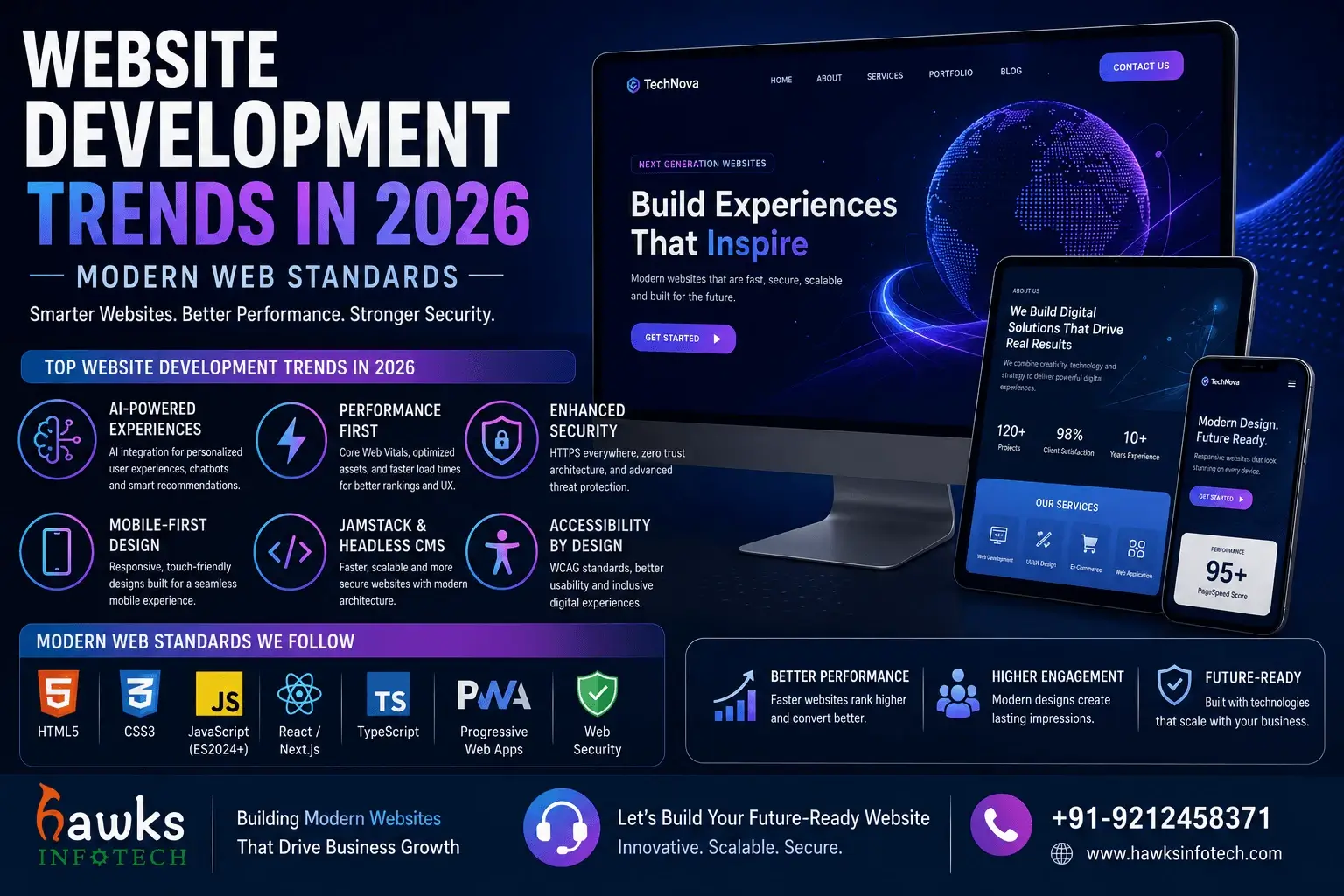
Over 68% of enterprise websites on the web today suffer from bloated JavaScript architectures, slow mobile loading speeds exceeding 4 seconds, poor Core Web Vitals scores, and outdated user interfaces that fail to convert modern consumers. In 2026, slow, non-responsive websites are heavily penalized by Google's mobile-first indexing and rejected by users who demand instantaneous, app-like web experiences.
Target Audience
This definitive web engineering briefing is created for Chief Technology Officers (CTOs), product managers, marketing directors, and business founders planning to build or redesign their corporate web presence.
What You Will Learn
You will discover the foundational architectural standards of 2026 web development: Server-Side Rendering (SSR) vs. Static Site Generation (SSG), headless CMS decoupling, AI-augmented personalization, sub-500ms Time-to-First-Byte (TTFB) engineering, and modern accessible UI design.
Core Topic Pillar: Website Development & Engineering
This pillar connects all supporting deep-dive guides and specialized execution blueprints in this cluster.
Quick Answer & Key Strategic Takeaway
In 2026, modern website development is defined by lightning-fast Server-Side Rendering (SSR), sub-500ms Core Web Vitals (INP, LCP, CLS), headless and API-first content architectures, strict WCAG 2.2 accessibility compliance, and built-in semantic JSON-LD structured data for Google AI Overviews and Generative Engine Optimization (GEO).
Table of Contents
Navigate the 10 critical web engineering benchmarks for 2026
- 01The 2026 Website Development Paradigm Shift
- 02Why Modern Web Standards Matter for Business ROI
- 03The 7 Core Standards of 2026 Web Engineering
- 04Transitioning from Heavy Monoliths to Lightweight Custom Architectures
- 05Optimizing Interaction to Next Paint (INP) for Instant Responsiveness
- 06Common Mistakes to Avoid in 2026
- 07Action Plan & Technical Comparison Matrix
- 08Frequently Asked Questions
- 09Website Development Topic Cluster
- 10Strategic Conclusion
1. The 2026 Website Development Paradigm Shift
The era of heavy, generic website themes loaded with 50+ plugins is officially over. Today's digital landscape is governed by search engines that prioritize milliseconds of latency and users who abandon any web page taking more than 2 seconds to render.
In 2026, web development has shifted from simple visual layout assembly to high-performance software engineering. Modern websites must be engineered as agile digital platforms that combine lightweight frontend code with resilient backend architectures capable of scaling to millions of concurrent visitors without performance degradation.
2. Why Modern Web Standards Matter for Business ROI
Adhering to modern web standards is not merely a technical checkbox—it is directly correlated with customer conversion rates, ad spend efficiency, and search rankings:
- Higher Conversion Rates: Every 100ms reduction in page load speed yields up to an 8% increase in conversion rates for B2B and e-commerce websites.
- Dominant Search Visibility: Google's Core Web Vitals algorithms rank lightning-fast, zero-layout-shift web pages ahead of sluggish competitor platforms.
- Lower Maintenance Overhead: Clean, custom-engineered code eliminates recurring plugin subscription fees and security patching nightmares.
3. The 7 Core Standards of 2026 Web Engineering
To outcompete established industry rivals, high-performing websites must implement seven non-negotiable architectural standards:
Server-Side Rendering (SSR) & Hybrid Hydration
Deliver pre-rendered HTML straight from the server for instant First Contentful Paint (FCP) and optimal SEO indexing, followed by lightweight client-side interactivity hydration.
Sub-Second Core Web Vitals & Next-Gen Formats
Enforce strict asset budgets: convert all graphics to compressed WebP/AVIF formats, inline critical CSS, and eliminate render-blocking JavaScript to achieve a 95+ Google PageSpeed score.
Mobile-First Responsive UI & Fluid Typography
Design for the smallest touchscreens first using flexible CSS Grid and Flexbox containers with responsive clamp() typography that scales smoothly from 360px mobile screens to 4K displays.
Headless API-First Architecture & Structured CMS
Decouple the frontend presentation layer from the backend content repository using REST or GraphQL APIs, allowing seamless content delivery across web, mobile apps, and IoT devices.
Semantic SEO & Multi-Tier Schema Markup
Implement proper HTML5 semantic tags (<header>, <main>, <article>, <nav>) and embed comprehensive JSON-LD schemas (Organization, Service, Breadcrumb, FAQPage) directly into server-rendered templates.
Accessible (WCAG 2.2 AA) & Inclusive Design
Ensure full keyboard navigation, high color contrast ratios, clear focus states, screen-reader ARIA tags, and native dark/light mode preference detection.
Hardened Enterprise Security & Strict CSP Headers
Implement SSL/TLS 1.3 encryption, automatic HTTPS redirection, strict CSP headers, SQL injection parameterized queries, and CSRF token protection to safeguard corporate and customer data.
4. Transitioning from Heavy Monoliths to Lightweight Custom Architectures
Deep-dive technical execution requires understanding real-world operational variables. Below is an authentic implementation scenario illustrating the measurable impact of modern web engineering:
An enterprise logistics company in Delhi NCR operated a legacy CMS site with 48 active plugins that took 6.2 seconds to load on mobile devices and scored 24/100 on Google PageSpeed. Our team re-engineered the platform using a lightweight custom PHP/Tailwind architecture with clean MySQL database queries. The new site loads in 0.6 seconds (a 90% speed improvement), achieved a 98/100 mobile PageSpeed score, and resulted in a 74% increase in organic lead form submissions within 60 days.
5. Optimizing Interaction to Next Paint (INP) for Instant Responsiveness
Scalable execution requires addressing workflow edge-cases and optimization trade-offs:
By deferring non-critical third-party analytics scripts, breaking up long JavaScript execution tasks, and utilizing CSS animations instead of heavy JavaScript animation libraries, the site maintains an average INP response time of 45ms, delivering instantaneous button feedback and smooth mobile scrolling.
6. Common Mistakes to Avoid in 2026
Organizations frequently undermine their performance by committing critical tactical errors. Guard against these costly pitfalls:
Mistake 1: Overloading with Plugin Bloat
Installing dozens of third-party plugins creates severe cybersecurity vulnerabilities and massive performance drag.
Mistake 2: Uncompressed Legacy Images
Using heavy uncompressed PNG/JPEG images instead of modern next-gen WebP and AVIF formats with responsive srcset tags.
Mistake 3: Pure Client-Side SPA Rendering Without SSR
Relying entirely on client-side JavaScript rendering without server-side rendering results in blank pages for search engine crawlers and poor organic indexation.
Mistake 4: Desktop-Only Layout Bias
Designing primarily for large monitors while neglecting the mobile smartphone viewport where 70%+ of traffic originates.
Mistake 5: Missing 301 URL Redirect Strategy
Launching website redesigns without setting up permanent 301 redirects from legacy URLs, causing catastrophic 404 error spikes and permanent ranking loss.
7. Action Plan & Technical Checklist
Use this structured comparison and audit matrix to benchmark your website's operational readiness:
| Development Standard | Legacy Web Development (2020) | Modern Web Engineering (2026) |
|---|---|---|
| Page Speed & TTFB | 2.5s to 5.0s load time | Sub-500ms instant streaming |
| Image Formats | Heavy JPEG & PNG (1MB+) | Compressed WebP & AVIF (< 80KB) with lazy loading |
| Core Web Vitals | Ignored or poorly optimized | Enforced LCP < 1.2s, INP < 100ms, CLS < 0.05 |
| CMS Architecture | Monolithic, plugin-heavy databases | Clean custom or headless API-first architectures |
| Mobile Optimization | Desktop-first with retrofitted CSS | 100% Mobile-First with fluid typography & touch targets |
| SEO Integration | Afterthought with third-party plugins | Baked into core semantic HTML & automated JSON-LD schemas |
8. Frequently Asked Questions
What is the most important web development trend in 2026?
The most critical trend is ultra-fast performance engineering driven by Server-Side Rendering (SSR) and Core Web Vitals optimization. Websites that load in under 1 second dramatically outperform competitors in both Google rankings and customer conversion rates.
How much does a custom, high-performance business website cost in India?
A professional, custom-engineered business website built to modern 2026 performance, security, and SEO standards typically ranges from ₹25,000 to ₹1,50,000 depending on custom feature requirements, database integrations, and dynamic capabilities.
What is the difference between WebP and AVIF image formats?
Both are next-generation image formats that compress image file sizes by 30% to 50% compared to JPEG/PNG without losing visual clarity. AVIF offers even higher compression ratios and superior color fidelity for photography.
Why is Interaction to Next Paint (INP) so important for SEO?
INP measures the responsiveness of your website to user interactions (clicking a menu, opening a tab, tapping a button). If a user taps a button and the page lags or freezes, Google penalizes the page's ranking score.
9. Website Development & Engineering Topic Cluster
Explore the complete interconnected network of pillar guides and specialized deep-dive articles in this domain:

WordPress vs Custom Website: Which Is Better for Your Business in 2026?
An exhaustive breakdown of development costs, security vulnerabilities, speed benchmarks, and long-term TCO.

How to Build an SEO-Friendly Website from Day One
Architectural best practices for crawl budgets, URL taxonomies, schema markup, and internal linking structures.
10. Strategic Conclusion
In 2026, website development is no longer just about aesthetics—it is a disciplined engineering practice where speed, mobile accessibility, security, and search engine machine-readability determine commercial success. By adopting modern web standards, server-side rendering, and Core Web Vitals excellence, your digital presence will outrank competitors and deliver unprecedented business growth.