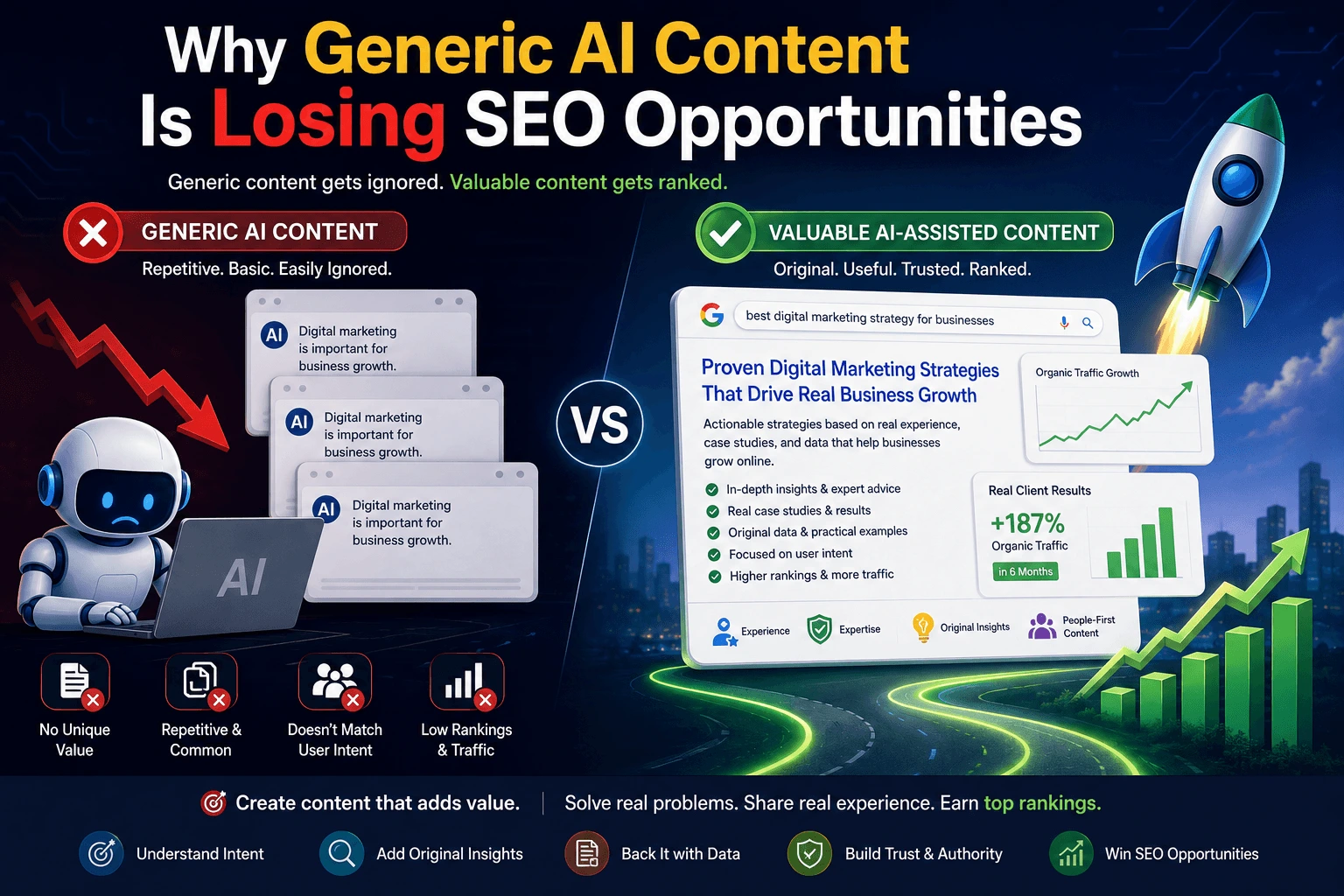
Across the global internet, millions of brands are generating hundreds of thousands of AI-authored articles every single week. Because Large Language Models are trained on existing web corpora, pure AI content inevitably restates the statistical average of what has already been published—producing vast oceans of generic, repetitive 'AI Slop' that offers zero original value.
In 2026, search algorithms at Google, Bing, and conversational engines like Perplexity have deployed sophisticated neural filters to identify and devalue this commodity content. When a user or algorithm encounters content that lacks fresh perspectives, proprietary data, and verified domain experience, it is immediately discarded. This comprehensive guide explains why generic AI copy fails to rank, analyzes the hidden business costs of publishing unedited automated content, and outlines how forward-thinking brands can build invincible, high-converting content moats.
Table of Contents
- 1. The Rise of the 'AI Slop' Phenomenon in Modern Search
- 2. The 4 Fatal Flaws of Commodity AI Articles
- 3. Algorithmic Devaluation: How Google Suppresses Generic Text
- 4. The Loss of Brand Trust & User Engagement Metrics
- 5. The 'Information Gain' Antidote to Commodity Content
- 6. How to Differentiate Your Content with Proprietary Assets
- 7. The Editorial Quality Standard for 2026
- 8. Action Plan: Turning Commodity Pages into High-Ranking Assets
- 9. Long-Term Strategic Positioning in the AI Era
- 10. Technical Implementation Framework
- 11. Key Strategic Takeaways & 2026 Checklist
- 12. Frequently Asked Questions
1. The Rise of the 'AI Slop' Phenomenon in Modern Search
When generative AI tools became widely accessible, many companies fired editorial teams and turned on automated content generation pipelines, believing that sheer volume would drive organic traffic.
The result was predictable: thousands of web pages offering identical 5-point lists, generic advice, and repetitive phrasing (such as 'in today's fast-paced digital landscape' or 'it is important to remember').
Search engines quickly realized that indexing 50 identical explanations of the same concept degraded user experience. In response, modern algorithms penalize sites filled with redundant material, demoting domains that produce repetitive copy.
The Commodity Content Trap (BLUF)
Generic AI content creates no Information Gain. Because it simply paraphrases existing web pages, search engines de-index it as redundant data.
2. The 4 Fatal Flaws of Commodity AI Articles
1. Zero Novelty: Commodity AI articles restate what is already well-known, offering zero new data points, unique methodologies, or distinct industry perspectives.
2. Absence of Real-World Experience: AI cannot physically repair a broken laptop motherboard, install an enterprise server rack in Gurgaon, or troubleshoot a live corporate firewall outage.
3. Superficial Depth: AI models write broadly about everything but deeply about nothing, leaving enterprise decision-makers without actionable technical solutions.
4. Lack of Brand Personality: Generic copy strips away corporate identity, making your business indistinguishable from hundreds of competitors.
When prospective B2B clients read generic AI fluff on your blog, they immediately conclude that your company lacks deep technical expertise. Bounce rates skyrocket, dwell times plummet, and form submissions drop to zero.
3. Algorithmic Devaluation: How Google Suppresses Generic Text
Google's Helpful Content System evaluates site-wide quality. When the majority of pages on a domain offer generic or derivative value, Google applies an algorithmic quality multiplier that suppresses impressions across the entire website.
This means publishing 100 low-quality AI posts can actively destroy the organic rankings of your high-converting core service pages.
Recovering from an algorithmic sitewide demotion requires months of aggressive content pruning, editorial rewriting, and original data injection.
4. The Loss of Brand Trust & User Engagement Metrics
Search algorithms evaluate user satisfaction through real-time feedback loops: click dwell time, scroll depth, and subsequent branded queries.
When visitors click a search result and encounter obvious automated copy, they immediately return to the search page. This 'pogosticking' behavior directly informs ranking algorithms that your page failed to deliver value.
5. The 'Information Gain' Antidote to Commodity Content
The antidote to generic AI content is Information Gain: the deliberate practice of publishing original statistics, client case studies, benchmark surveys, and contrarian expert opinions.
When your content contains unique facts that exist nowhere else on the web, search algorithms are forced to index and cite your website as the primary originating source.
Information Gain turns your website from a passive consumer of web knowledge into an indispensable originator of industry intelligence.
6. How to Differentiate Your Content with Proprietary Assets
1. Publish annual or quarterly industry benchmark reports based on real client engagements.
2. Include real client case studies detailing exact problem-solving steps, part numbers, and measurable results.
3. Embed custom interactive calculators, pricing estimation tools, or workflow diagrams.
4. Feature verified author bylines from senior technical engineers and certified consultants with active Schema.org markup.
7. The Editorial Quality Standard for 2026
Every article published on your website should pass the 'Three Unique Facts' test: If a piece does not contain at least three verifiable facts, tables, or case examples not found in competing articles, it should not be published.
This strict editorial threshold guarantees that every published asset contributes tangible value to your topical authority.
8. Action Plan: Turning Commodity Pages into High-Ranking Assets
1. Audit existing blog posts and identify underperforming AI-generated content.
2. Consolidate thin, overlapping articles into comprehensive pillar guides.
3. Inject real project photos, custom screenshots, and proprietary client metrics.
4. Add structured BLUF summary boxes and HTML comparison tables.
9. Long-Term Strategic Positioning in the AI Era
As automated text generation accelerates, authentic human expertise becomes increasingly scarce and valuable. Brands that invest in proprietary research and verified case execution will command dominant market share in both traditional search and AI answer engines.
Generic AI Content vs. High-Information-Gain Content
| Attribute | Generic AI Content (AI Slop) | High-Information-Gain Content |
|---|---|---|
| Source Material | Restates existing web summaries | Proprietary client case studies & original benchmarks |
| Search Performance | Algorithmic devaluation & traffic collapse | Stable top-3 rankings & frequent AI citations |
| Visitor Perception | Low trust, high bounce rate | High authority, high conversion into leads |
| E-E-A-T Proof | None (anonymous author) | Verified engineers, real photos, certified bylines |
| Conversion Rate | Below 0.5% | 3.5% to 6.8% into qualified inquiries |
10. Strategic Execution & Technical Architecture
To successfully execute the principles outlined in this guide, modern digital teams must bridge high-level editorial strategy with rigorous technical engineering. The modern search landscape evaluates websites through automated neural extractors that penalize structural ambiguity and reward clean, machine-readable data formatting.
By implementing structured JSON-LD Schema markup, optimizing Time-to-First-Byte (TTFB) to under 500 milliseconds, establishing verified author credential nodes, and maintaining active Knowledge Graph disambiguation, your brand establishes permanent organic and generative authority.
Modern search engines use automated crawlers that operate on strict render budgets. If a website depends entirely on heavy client-side JavaScript frameworks to render its core comparison tables or author biographies, headless AI bots (such as GPTBot, Google-Extended, and PerplexityBot) may fail to extract the underlying factual claims. Ensuring server-side rendering (SSR) or pure semantic HTML streaming is essential for maximum discovery.
// Recommended Entity Schema Node for Modern Search Engines
{ "@context": "https://schema.org", "@type": "ProfessionalService", "name": "Hawks Infotech", "url": "https://hawksinfotech.com", "areaServed": ["Delhi", "Noida", "Gurgaon", "India"], "sameAs": [ "https://www.wikidata.org/wiki/Special:Search?search=Hawks+Infotech", "https://www.linkedin.com/company/hawks-infotech" ] }
When search engine crawlers and real-time AI scrapers encounter this level of technical precision paired with deep, firsthand domain expertise, your website naturally secures prime placement in search indices and conversational AI citation carousels.
11. Key Strategic Takeaways & 2026 Action Checklist
As search behavior continues to evolve rapidly across desktop, mobile, and voice interfaces, business leaders must maintain a clear, disciplined execution roadmap. Below is an executive summary of the foundational actions required to dominate your category:
1. Prioritize Information Gain Above All Else
Never publish generic summaries that restate common web knowledge. Ensure every page contributes at least 2-3 proprietary metrics, case results, or unique analytical viewpoints.
2. Build Structured Machine-Readable Assets
Format key pricing tiers, technical specifications, and SLA guarantees in semantic HTML tables accompanied by 50-word BLUF answer capsules under every major heading.
3. Prove Unassailable Firsthand Experience (E-E-A-T)
Feature verified author bylines linked to certified credentials and LinkedIn profiles. Replace generic stock imagery with authentic photos from real client engagements and engineering workshops.
4. Maintain Sub-Second Technical Infrastructure
Guarantee sub-300ms server response times, eliminate render-blocking resources, and confirm that all major AI crawler bots are permitted in your server's robots.txt file.
12. Frequently Asked Questions
Can we still use AI tools for writing assistance?
Yes! Use AI for research outlining, grammar refinement, and formatting, but ensure human subject-matter experts provide the original insights, case data, and final editorial review.
How do we recover from a drop caused by low-quality AI content?
Prune or delete thin, unhelpful articles, consolidate duplicate topics into deep pillar guides, and inject genuine firsthand experience across your remaining core pages.
How does Information Gain affect AI Overviews?
AI engines specifically look for unique facts to include in their synthesized summaries. Content with high Information Gain is 4x more likely to be selected as a citation source.
Scale Your Authority in 2026
Ready to Dominate Search & AI Overviews?
Partner with Hawks Infotech's senior digital marketing and SEO architects to transform your website into an authoritative industry benchmark.
Explore Authoritative Content Marketing Book Free Consultation