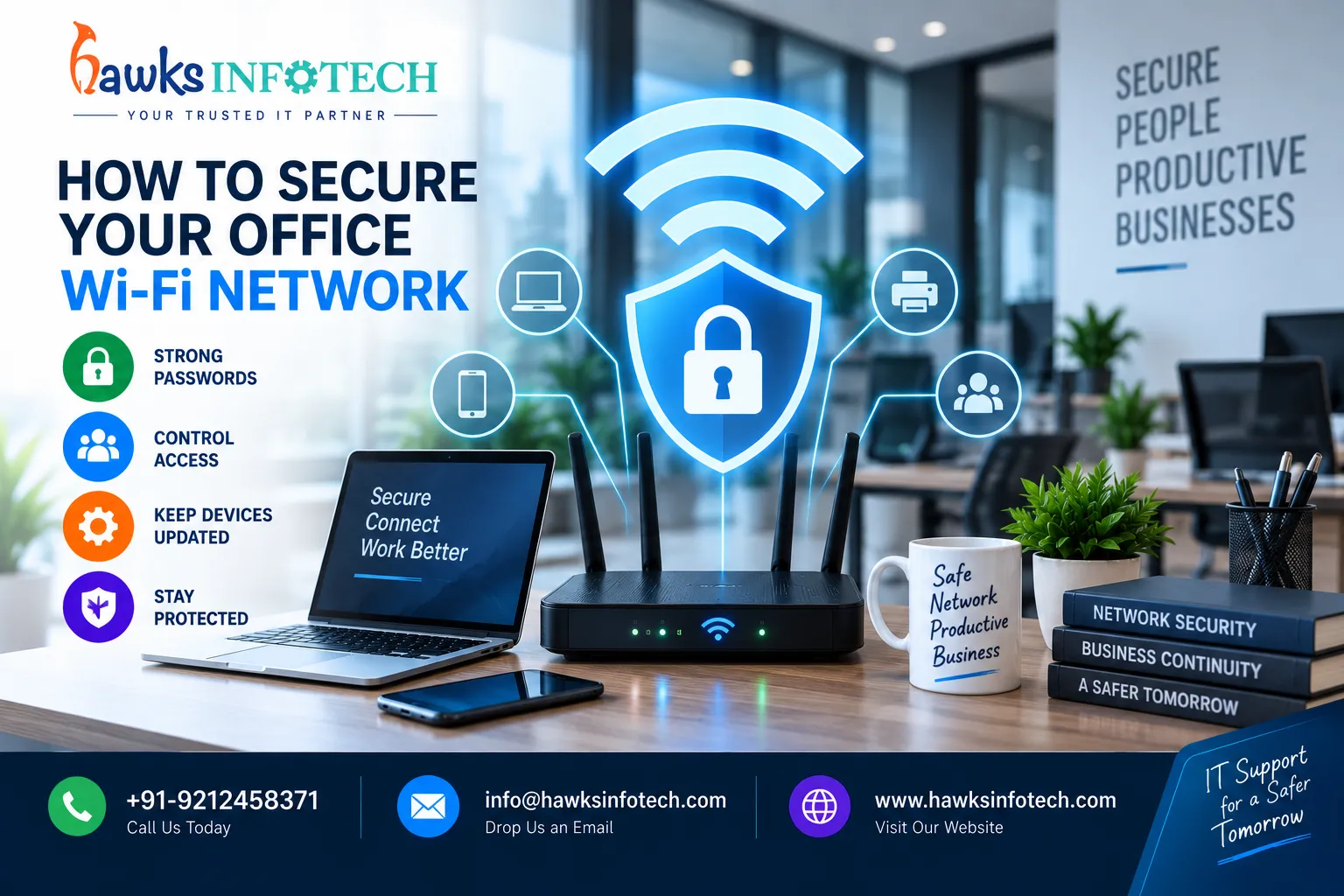
Your office Wi-Fi network is the invisible gateway to your company's core financial records, internal servers, customer databases, and employee workstations. Yet in many small and mid-sized offices, wireless networks still rely on basic pre-shared passwords, consumer-grade routers, and unsegmented access. This allows visitors, contractors, and rogue actors in the parking lot to eavesdrop on unencrypted network traffic and execute man-in-the-middle attacks.
Target Audience
Office administrators, network engineers, and business leaders who want to bulletproof their wireless infrastructure against unauthorized eavesdropping and cyber intrusion.
What You Will Learn
How to implement WPA3 Enterprise wireless encryption, configure isolated guest and IoT VLANs, disable dangerous legacy protocols, and detect rogue access points.
Supporting Deep-Dive Guide
Master Pillar: How AI Is Changing Cybersecurity in 2026
Quick Answer & Strategic Summary
Securing your office Wi-Fi requires upgrading to WPA3-Enterprise encryption with 802.1X RADIUS authentication, isolating guest and IoT devices onto separate Virtual LANs (VLANs), disabling WPS and remote router management, hiding or securing SSID broadcasts, and conducting periodic wireless rogue access point scans.
Table of Contents
1 What Constitutes a Secure Commercial Office Wi-Fi Architecture?
A secure commercial office Wi-Fi network isolates sensitive business systems from non-critical devices through hardware-level cryptographic segmentation. Unlike residential setups that use a single shared password for all connected devices, enterprise Wi-Fi assigns unique authentication credentials to every employee and strictly controls device permissions.
Modern enterprise wireless utilizes centralized controller management, automated client isolation, continuous RF spectrum monitoring, and firewall inspection for all inbound and outbound wireless traffic.
2 The High Stakes of Insecure Wireless Networks in 2026
With high-gain antennas and automated Wi-Fi cracking tools, malicious actors can capture wireless handshakes from hundreds of meters away outside your office building. Once an attacker gains access to an unsegmented office Wi-Fi network, they can scan for open ports, deploy network sniffers, and launch ARP poisoning attacks against connected laptops.
Furthermore, IoT hardware such as smart TVs, wireless printers, and CCTV cameras frequently contain unpatched firmware vulnerabilities that attackers exploit as lateral entry points into primary business servers.
3 Step-by-Step Guide to Hardening Your Office Wi-Fi Network
Upgrade to WPA3-Enterprise Encryption with 802.1X Authentication
Replace outdated WPA2-Personal pre-shared keys with WPA3-Enterprise. Each user logs in with their individual domain credentials, eliminating shared password leakage.
Implement Strict VLAN Network Segmentation
Create 3 distinct Virtual LANs: VLAN 10 for Corporate Workstations, VLAN 20 for Guest Wi-Fi (internet-only access), and VLAN 30 for Office IoT (printers, smart displays, CCTV).
Disable Wi-Fi Protected Setup (WPS) and Remote Admin Access
WPS contains known PIN brute-force vulnerabilities. Turn off WPS permanently and ensure web management interfaces are accessible only via physical Ethernet cables.
Enable Wireless Client Isolation on Guest Networks
Prevent guest devices from communicating with or discovering each other on the local network, stopping visitor malware from spreading to other laptops.
Deploy Rogue Access Point Detection and Heatmap Audits
Use wireless monitoring tools to detect unauthorized personal hotspots (Evil Twin APs) plugged into office wall ports by employees or external intruders.
4 Advanced Architectural Analysis & Deep-Dives
The Critical Danger of IoT Devices on Corporate Wi-Fi
Real-World Architecture: Isolating Smart Devices and PrintersA financial advisory firm in Connaught Place, New Delhi suffered a breach when an unpatched smart conference room TV was compromised. Attackers used the TV's wireless interface to pivot onto the accounting department's shared network drive. By re-architecting the network with Hawks Infotech VLAN micro-segmentation and access control lists (ACLs), IoT hardware was isolated to a dedicated internet-only pipe with zero access to internal financial records.
Preventing 'Evil Twin' Attacks and Wi-Fi Eavesdropping
Technical Deep-Dive: Certificate-Based Wi-Fi AuthenticationAttackers often deploy rogue Wi-Fi access points broadcasting your exact office network name to capture employee credentials. Deploying 802.1X EAP-TLS certificate-based authentication ensures that company laptops will only connect to verified, cryptographically signed corporate access points, rendering Evil Twin attacks completely ineffective.
5 Critical Pitfalls & Mistakes to Avoid
Using the same Wi-Fi network and password for both internal servers and visitor guest laptops.
Leaving default factory passwords on commercial access points and router administrative consoles.
Failing to revoke Wi-Fi access immediately when an employee or contractor leaves the company.
Using obsolete WEP or WPA security protocols that can be cracked in under 60 seconds with free software.
6 Strategic Comparison & Technical Specifications
| Wi-Fi Security Standard | Encryption Algorithm | Authentication Method | Recommended Usage (2026) |
|---|---|---|---|
| WEP (Legacy) | 64/128-bit RC4 (Broken) | Static Shared Key | Obsolete — Never Use |
| WPA2-Personal (PSK) | AES-CCMP | Single Shared Passphrase | Acceptable for Home; Insecure for Business |
| WPA2-Enterprise | AES-CCMP / 802.1X | Individual User / RADIUS | Standard Minimum for Business |
| WPA3-Enterprise (192-bit) | CNSA Suite / GCMP-256 | EAP-TLS / Cryptographic Certificates | Gold Standard for Corporate Security |
| Guest VLAN with Isolation | AES with Client Isolation | Captive Portal / Ephemeral Passwords | Mandatory for Visitors & Contractors |
7 Frequently Asked Questions (FAQs)
What is the difference between WPA2-Personal and WPA3-Enterprise?
WPA2-Personal uses a single shared password for all users, meaning anyone with the password can decrypt nearby wireless traffic. WPA3-Enterprise assigns unique 192-bit cryptographic keys to each individual user through a centralized authentication server (RADIUS), ensuring that users cannot decrypt each other's data packets.
Should businesses hide their office Wi-Fi SSID (network name)?
Hiding your SSID provides negligible security because network scanners easily detect hidden networks during client probe requests. Strong WPA3 encryption and 802.1X authentication provide infinitely greater protection than hiding an SSID.
How do I prevent guests from accessing company files over Wi-Fi?
Place all guest traffic onto a dedicated Virtual LAN (VLAN) with Client Isolation and Access Control Lists (ACLs) enabled on your firewall, ensuring guests can only access the public internet and cannot ping internal computers.
How often should office Wi-Fi passwords be changed?
If using shared passwords, change them at least quarterly and immediately after staff terminations. If using WPA3-Enterprise with individual user accounts, access is automatically revoked when an employee's domain account is disabled.
Explore Related Cybersecurity & AI Threat Defense Guides
Cluster Hub8 Strategic Takeaway & Action Plan
Securing your commercial office Wi-Fi is a fundamental pillar of corporate cybersecurity. Upgrading to WPA3-Enterprise, isolating guests on dedicated VLANs, and establishing active rogue AP detection safeguards your proprietary data from eavesdropping and perimeter breaches.
Ready to Upgrade Your Network & Wi-Fi Security Services?
Partner with Hawks Infotech for verified SLAs, certified engineers, proactive 24/7 monitoring, and high-performance execution in Delhi NCR and across India.