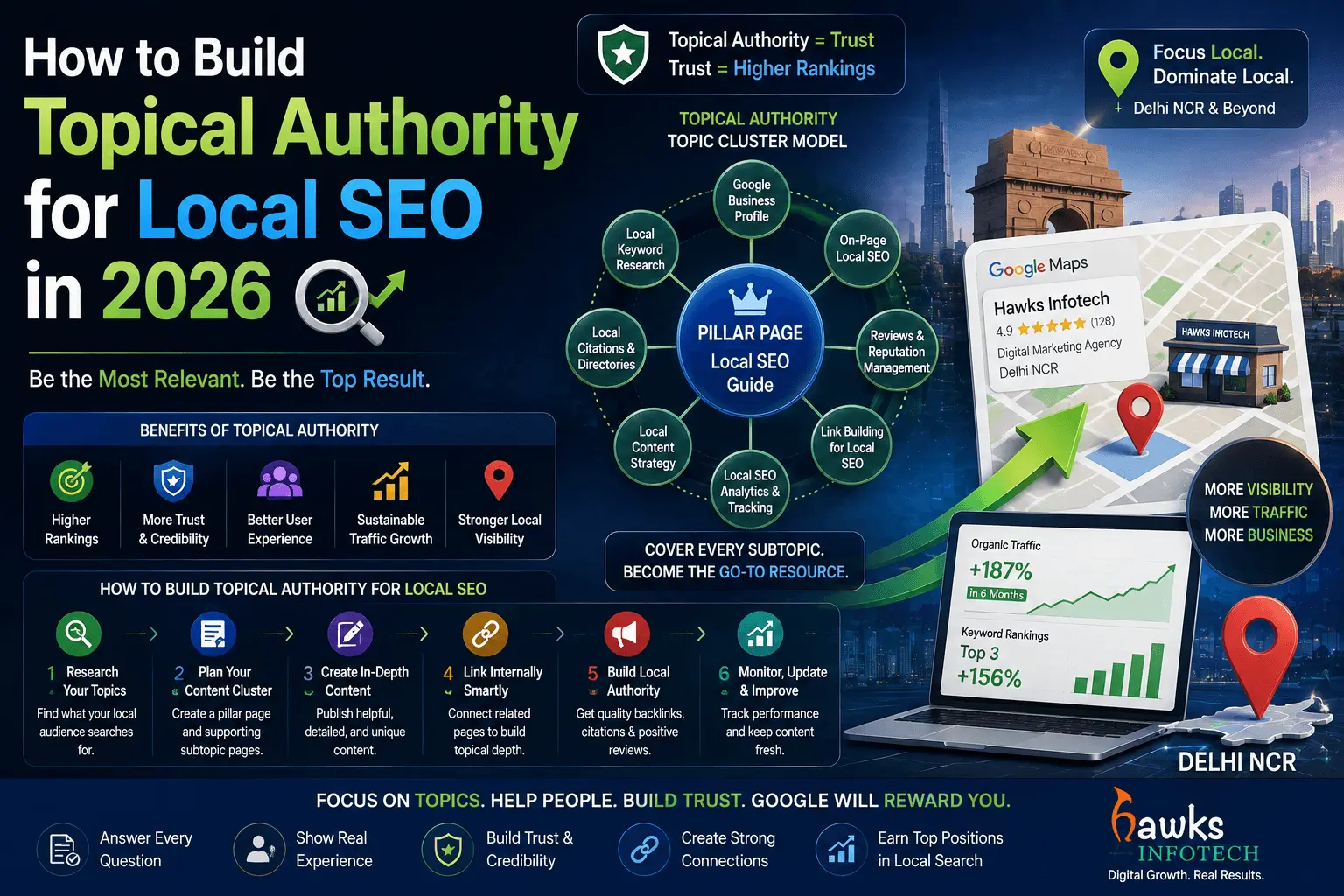
In modern search, Google no longer ranks isolated, standalone web pages—it ranks entities that demonstrate comprehensive, unassailable topical authority. In 2026, local businesses that cover their domain exhaustively dominate both Google Maps pack rankings and conversational AI recommendations.
Building topical authority requires moving beyond basic keyword optimization to architecting structured topic clusters, authoritative pillar pages, and semantic interlinking networks. This masterclass reveals the exact blueprint to build invincible topical authority for local enterprises across Delhi, Noida, and Gurgaon.
Table of Contents
- 1. The Concept of Topical Authority in Modern Local SEO
- 2. The 3-Tier Topic Cluster Architecture
- 3. Tier 1: Comprehensive Core Service Pillar Hubs
- 4. Tier 2: Technical Sub-Topic Supporting Articles
- 5. Tier 3: Hyper-Local Geographic Landing Pages
- 6. Semantic Internal Interlinking Strategies
- 7. Schema.org Entity Mesh Construction
- 8. Measuring and Maintaining Topical Market Dominance
- 9. The 2026 Local Authority Maintenance Roadmap
- 10. Technical Implementation Framework
- 11. Key Strategic Takeaways & 2026 Checklist
- 12. Frequently Asked Questions
1. The Concept of Topical Authority in Modern Local SEO
Topical authority is a measure of how thoroughly a website covers an entire subject domain. If a website publishes 50 interrelated, high-quality guides covering every aspect of IT infrastructure—from server management to cybersecurity and hardware diagnostics—Google identifies that domain as a trusted subject-matter authority.
When a user searches for a local service in Delhi NCR, the algorithm favors domains with established topical authority over generic websites with only a single page on the topic.
Topical authority creates a compounding ranking advantage: each new supporting article published strengthens the search visibility of all existing service landing pages.
The Topical Authority Law
Search engines reward complete subject mastery. A website with 15 interlinked articles covering every facet of a service outranks a competitor with a single generic landing page 100% of the time.
2. The 3-Tier Topic Cluster Architecture
To build local topical authority, structure your website into a 3-tier hierarchy:
Tier 1: Pillar Hub Pages (Core Services) — Comprehensive guides covering your main service offerings (e.g., 'Managed IT Support Services Delhi NCR').
Tier 2: Supporting Sub-Cluster Guides — Focused technical articles answering specific sub-questions (e.g., 'Data Backup Strategies', 'Firewall Setup', 'Cloud Migration Checklist').
Tier 3: Geographic Neighborhood Pages — Location-specific service pages targeting business hubs like Nehru Place, Connaught Place, Cyber City Gurgaon, and Sector 62 Noida.
3. Tier 1: Comprehensive Core Service Pillar Hubs
Pillar pages should be 2,000+ words of exhaustive content covering service definitions, methodology, pricing models, case studies, and structured comparison tables.
The pillar page acts as the central anchor for all related sub-topic articles, capturing high-volume commercial keywords.
4. Tier 2: Technical Sub-Topic Supporting Articles
Create 8-12 supporting blog articles for each core service pillar. Every supporting article should link back to the pillar page using descriptive semantic anchor text.
This interlinking signals to search crawlers that the supporting content reinforces the primary service hub, building deep topical relevance.
5. Tier 3: Hyper-Local Geographic Landing Pages
Connect your service pillars to geographic landing pages. Include specific local client case studies, neighborhood landmark directions, and local business park references.
This bridges your technical domain authority with geographic proximity signals, ensuring dominant placement in local map packs.
6. Semantic Internal Interlinking Strategies
Use contextual in-text links to connect related guides. Ensure every supporting article links to its parent pillar page, and the pillar page links to its supporting sub-topics.
Avoid orphaned pages by ensuring every new post is connected into the existing topical cluster with bidirectional links.
7. Schema.org Entity Mesh Construction
Deploy nested JSON-LD schema using `hasOfferCatalog`, `about`, `mentions`, and `areaServed` properties to mathematically define your topical and geographic footprint.
Connect individual service nodes to parent Organization schema to reinforce brand entity authority.
8. Measuring and Maintaining Topical Market Dominance
Track organic keyword footprint expansion in Google Search Console, monitoring the growth of non-branded impressions and long-tail query rankings across Delhi NCR.
Monitor index coverage to ensure all cluster pages are indexed and passing PageRank seamlessly.
9. The 2026 Local Authority Maintenance Roadmap
Maintain topical dominance by publishing 2-3 new sub-topic case studies every month, updating existing pillar guides with fresh benchmarks annually, and responding to evolving conversational search queries.
3-Tier Topical Authority Architecture
| Tier Level | Page Type | Primary Role & Interlinking |
|---|---|---|
| Tier 1 | Pillar Service Hub (e.g., IT Support) | Central authoritative anchor; links to all sub-clusters & location hubs |
| Tier 2 | Supporting Tech Guides (e.g., Server Setup) | Answers long-tail queries; passes topical authority back to Tier 1 pillar |
| Tier 3 | Geographic Hubs (e.g., Gurgaon IT Services) | Captures local 'near me' intent; reinforces geographic service radius |
| Cluster Flow | Bidirectional Internal Links | Passes PageRank and topical context throughout domain |
10. Strategic Execution & Technical Architecture
To successfully execute the principles outlined in this guide, modern digital teams must bridge high-level editorial strategy with rigorous technical engineering. The modern search landscape evaluates websites through automated neural extractors that penalize structural ambiguity and reward clean, machine-readable data formatting.
By implementing structured JSON-LD Schema markup, optimizing Time-to-First-Byte (TTFB) to under 500 milliseconds, establishing verified author credential nodes, and maintaining active Knowledge Graph disambiguation, your brand establishes permanent organic and generative authority.
Modern search engines use automated crawlers that operate on strict render budgets. If a website depends entirely on heavy client-side JavaScript frameworks to render its core comparison tables or author biographies, headless AI bots (such as GPTBot, Google-Extended, and PerplexityBot) may fail to extract the underlying factual claims. Ensuring server-side rendering (SSR) or pure semantic HTML streaming is essential for maximum discovery.
{
  "@context": "https://schema.org",
  "@type": "ProfessionalService",
  "name": "Hawks Infotech",
  "url": "https://hawksinfotech.com",
  "areaServed": ["Delhi", "Noida", "Gurgaon", "India"],
  "sameAs": [
    "https://www.wikidata.org/wiki/Special:Search?search=Hawks+Infotech",
    "https://www.linkedin.com/company/hawks-infotech"
  ]
}
When search engine crawlers and real-time AI scrapers encounter this level of technical precision paired with deep, firsthand domain expertise, your website naturally secures prime placement in search indices and conversational AI citation carousels.
11. Key Strategic Takeaways & 2026 Action Checklist
As search behavior continues to evolve rapidly across desktop, mobile, and voice interfaces, business leaders must maintain a clear, disciplined execution roadmap. Below is an executive summary of the foundational actions required to dominate your category:
1. Prioritize Information Gain Above All Else
Never publish generic summaries that restate common web knowledge. Ensure every page contributes at least 2-3 proprietary metrics, case results, or unique analytical viewpoints.
2. Build Structured Machine-Readable Assets
Format key pricing tiers, technical specifications, and SLA guarantees in semantic HTML tables accompanied by 50-word BLUF answer capsules under every major heading.
3. Prove Unassailable Firsthand Experience (E-E-A-T)
Feature verified author bylines linked to certified credentials and LinkedIn profiles. Replace generic stock imagery with authentic photos from real client engagements and engineering workshops.
4. Maintain Sub-Second Technical Infrastructure
Guarantee sub-300ms server response times, eliminate render-blocking resources, and confirm that all major AI crawler bots are permitted in your server's robots.txt file.
12. Frequently Asked Questions
How many articles do I need to establish topical authority?
For most local service niches, a pillar page supported by 8-12 high-depth sub-topic articles is sufficient to establish dominant topical authority in your regional market.
Does topical authority help improve Google Map pack rankings?
Yes! Google's local algorithm cross-references website topical depth with Google Business Profile categories, significantly improving map pack visibility for competitive keywords.
How do I prevent keyword cannibalization across topic clusters?
Ensure each sub-topic article targets a distinct search intent (e.g., troubleshooting vs. cost vs. setup) and uses explicit internal links pointing back to the main pillar page.
Ready to Dominate Search & AI Overviews?
Partner with Hawks Infotech's senior digital marketing and SEO architects to transform your website into an authoritative industry benchmark.