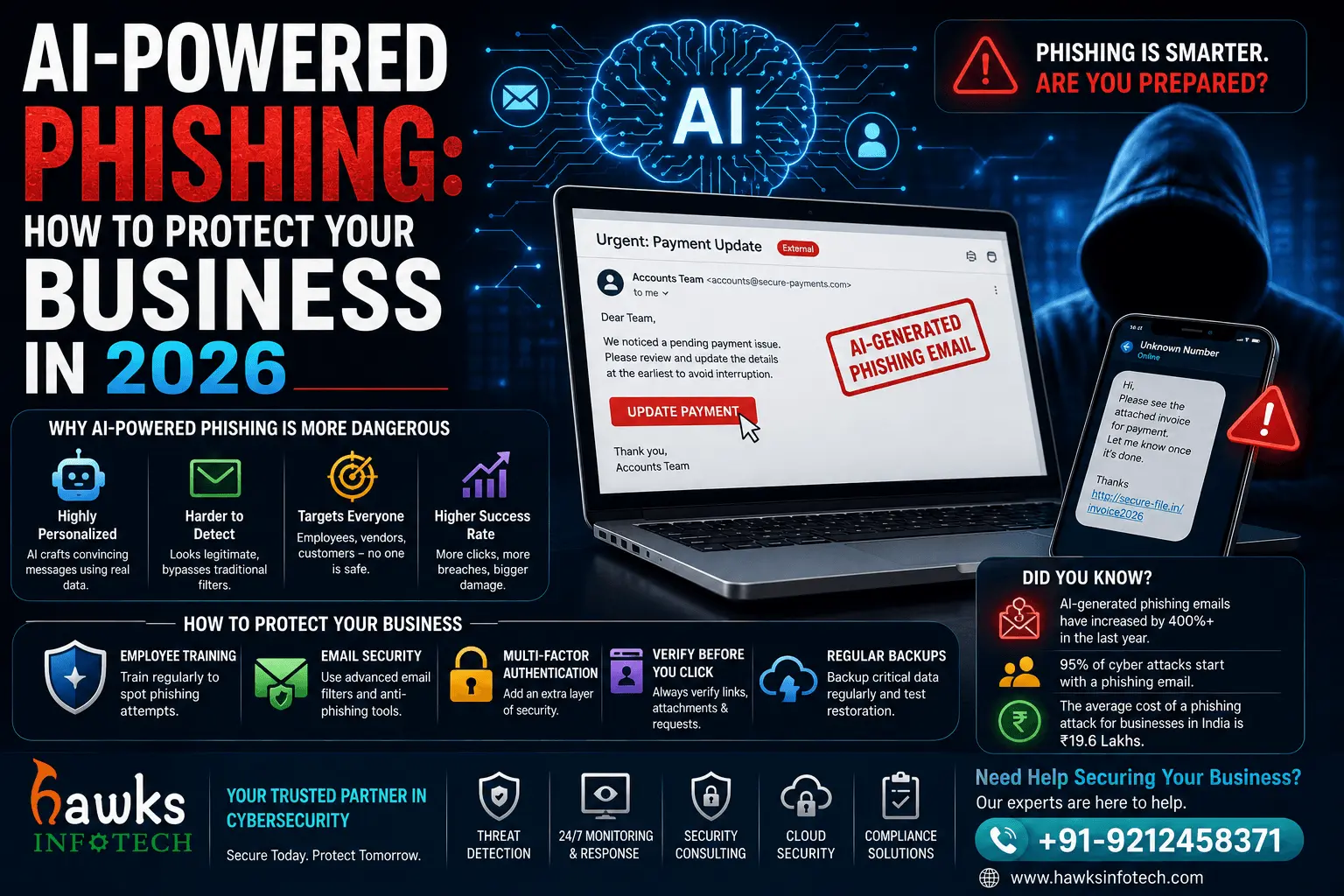
Gone are the days when phishing emails were easy to spot with broken English, spelling mistakes, and generic greetings. In 2026, cybercriminals use Large Language Models (LLMs) and generative voice cloning to craft flawless, hyper-personalized spear-phishing emails and deepfake audio messages that mimic company CEOs, corporate vendors, and legal authorities with terrifying precision.
Target Audience
This actionable security guide is designed for Chief Financial Officers (CFOs), human resources directors, IT security administrators, and corporate employees across Indian businesses.
What You Will Learn
You will learn the mechanics of modern AI phishing: how deepfake CEO voice clones manipulate wire transfers, how to configure SPF/DKIM/DMARC email authentication records, and how to institute dual-control financial verification procedures.
Supporting Deep-Dive Guide
Pillar Parent: Top Cybersecurity Threats for Indian Businesses in 2026
Quick Answer & Key Strategic Takeaway
To protect against AI-powered phishing, enforce DMARC policy with strict quarantine/reject alignment, deploy AI-driven email behavioral filters that analyze communication tone and domain spoofing, mandate hardware security key MFA (FIDO2), and implement a strict verbal callback verification protocol for all financial transfers exceeding threshold limits.
Table of Contents
1. What Is AI-Powered Phishing and How Does It Work?
AI-powered phishing is the malicious use of artificial intelligence tools—such as generative language models, automated web scrapers, and neural voice synthesis—to produce highly realistic, contextually relevant social engineering attacks at massive scale.
Attackers train AI tools on an executive's public LinkedIn posts, podcast interviews, and company press releases. The AI then writes emails mimicking the executive's exact tone, writing cadence, and vocabulary, targeting finance personnel with requests for urgent invoice settlements or wire transfers.
In its most dangerous form, attackers use 3-second audio samples from public speeches to generate real-time voice clones, calling junior employees and ordering immediate fund transfers.
2. Why Traditional Email Filters Fail Against AI Phishing in 2026
Legacy secure email gateways (SEGs) rely on blacklists of known malicious URLs, file attachments, and historical spam trigger words. AI-generated phishing emails use clean, newly registered domains, contain no malware attachments, and use polite, professional corporate language.
Business Email Compromise (BEC) and AI phishing account for over 54% of all financial cybercrime losses in India, with single fraudulent transactions often exceeding ₹50 Lakhs to ₹5 Crores.
Without advanced behavioral AI email analysis and strict procedural verification safeguards, human employees cannot reliably distinguish legitimate executive communications from AI-generated counterfeits.
3. 5 Technical Safeguards to Neutralize AI Phishing Attacks
To execute this strategy with maximum efficiency, implement the following prioritized step-by-step framework:
Enforce Full DMARC, DKIM, and SPF Email Protocols
Configure strict DMARC (`p=reject`) policies on all corporate email domains. This prevents cybercriminals from sending emails that directly spoof your exact company domain name.
Deploy Natural Language Processing (NLP) Email Security
Upgrade to modern cloud email security (such as Microsoft Defender for Office 365 or Google Workspace Advanced Threat Protection) that uses behavioral NLP to detect sudden changes in executive communication patterns and display external sender warning banners.
Mandate Hardware-Backed FIDO2 Multi-Factor Authentication
Eliminate SMS and email OTPs, which can be intercepted by reverse-proxy phishing kits (like Evilginx). Deploy hardware security keys (YubiKey) or Windows Hello / Touch ID biometric authentication.
Establish Out-of-Band Financial Verification Protocols
Institute an unbreakable corporate rule: Any request to alter vendor bank account details, routing codes, or execute wire transfers above ₹1 Lakh must be verified via a secondary, pre-established phone number or in-person confirmation.
Conduct Adaptive AI Phishing Simulation Training
Train staff using realistic, AI-generated simulation scenarios tailored to their specific job roles (e.g., HR receiving spoofed resumes, accounts receiving urgent vendor invoices).
4. Dissecting Deepfake CEO Voice Scams (Vishing)
Deep-dive technical execution requires understanding real-world operational variables. Below is an authentic implementation scenario illustrating the measurable impact of this methodology:
Practical Example: Real-World Corporate Scam Breakdown
A real estate developer in Gurgaon received a WhatsApp voice note seemingly from the Managing Director requesting an immediate advance payment of ₹35 Lakhs to a new land acquisition consultant. The voice tone, Hindi accent, and urgency matched the MD perfectly. Fortunately, the accounts manager followed the company's out-of-band verification protocol, called the MD on his registered personal phone, and uncovered that the voice note was an AI deepfake generated from a recent YouTube interview.
5. Detecting Lookalike and Homoglyph Domain Spoofing
Scalable execution requires addressing workflow edge-cases and optimization trade-offs:
Practical Example: Vendor Email Impersonation
Attackers registered `hаwksinfotech.com` (using a Cyrillic 'а' character instead of Latin 'a') to email corporate clients with updated bank account details for invoice settlement. Deploying domain monitoring alerts and configuring email filters to flag homoglyph character substitutions prevents these deceptive emails from ever entering employee inboxes.
6. Common Mistakes to Avoid in 2026
Organizations frequently undermine their performance by committing critical tactical errors. Guard against these costly pitfalls:
Mistake 1: Relying on email confirmation alone to verify a changed vendor bank account.
Mistake 2: Displaying full employee email directories on public websites (provides a ready target list for spear-phishing bots).
Mistake 3: Leaving SPF records set to soft-fail (`~all`) instead of hard enforcement (`-all`).
Mistake 4: Shaming or punishing employees who click on simulation links rather than providing constructive educational feedback.
Mistake 5: Assuming small businesses are too small to be targeted by automated AI phishing tools.
7. Action Plan & Technical Checklist
Use this structured comparison and audit matrix to benchmark your operational readiness:
| Phishing Characteristic | Traditional Phishing (Legacy) | AI-Powered Phishing (2026) |
|---|---|---|
| Grammar & Language | Poor spelling, awkward syntax | Flawless, fluent corporate English & vernacular Hindi |
| Personalization | Generic 'Dear Customer' greetings | Hyper-personalized referencing recent client projects & vendors |
| Attack Vectors | Malicious links & EXE attachments | Text-only requests, deepfake voice notes & clean lookalike domains |
| Creation Velocity | Manual, slow, repetitive | Automated generation of thousands of custom emails per minute |
| Detection Difficulty | Easy to identify by trained eyes | Virtually indistinguishable without technical DMARC & NLP filters |
8. Frequently Asked Questions
How can I tell if a voice message or call is an AI deepfake?
Listen for unnatural breathing pauses, robotic micro-artifacts, lack of background room noise, and refusal to answer spontaneous tangential questions. Always verify unexpected financial requests via a direct return phone call on a verified number.
What is DMARC and why is it essential?
Domain-based Message Authentication, Reporting, and Conformance (DMARC) is an email authentication protocol that tells recipient servers to reject or quarantine any email claiming to come from your domain that fails cryptographic validation.
Are free webmail accounts (Gmail/Yahoo) safe for business communication?
No. Free webmail accounts lack enterprise security controls, custom DMARC authentication, audit logging, and behavioral threat detection, making them easy targets for impersonation.
What should an employee do immediately after clicking a phishing link?
1) Immediately disconnect the PC from the network (unplug ethernet / turn off Wi-Fi), 2) Alert the IT security team, 3) Reset account passwords from a separate, clean device, and 4) Terminate all active browser login sessions.
9. Cybersecurity & IT Infrastructure Topic Cluster
Explore the complete interconnected network of pillar guides and specialized deep-dive articles in this domain:

Top Cybersecurity Threats for Indian Businesses in 2026
Explore the comprehensive master guide that unifies all Cybersecurity & IT Infrastructure strategies.
Top Cybersecurity Threats for Indian Businesses in 2026

Managed IT Support vs In-House IT Team: Complete ROI & Cost Analysis
10. Strategic Conclusion
AI-powered phishing represents a fundamental shift in corporate security risk. Defending against these sophisticated threats requires a multi-layered defense combining rigorous DMARC authentication, behavioral AI email security, hardware-backed multi-factor authentication, and strict procedural financial verification safeguards across your organization.
Ready to Upgrade Your Email Security & Anti-Phishing Defense?
Partner with Hawks Infotech's senior technology specialists and digital marketing architects to transform your business into an industry benchmark.